Quick answer
A Security Operations Center (SOC) splits its workers into three tiers. Tier 1 checks alerts and clears false alarms. Tier 2 digs into real threats and stops them. Tier 3 hunts hidden threats and leads the response to big attacks. Today, AI does most of Tier 1's repetitive work.
| Tier | Role | Experience |
|---|---|---|
| Tier 1 | Alert triage | 0-2 years |
| Tier 2 | Incident response | 1-4 years |
| Tier 3 | Threat hunting & forensics | 4+ years |
What Does SOC Stand for in Cyber Security?
SOC stands for Security Operations Center. It's the team that watches your systems for threats all day and all night. Every alert goes through the SOC first. So does every login, and every odd file.
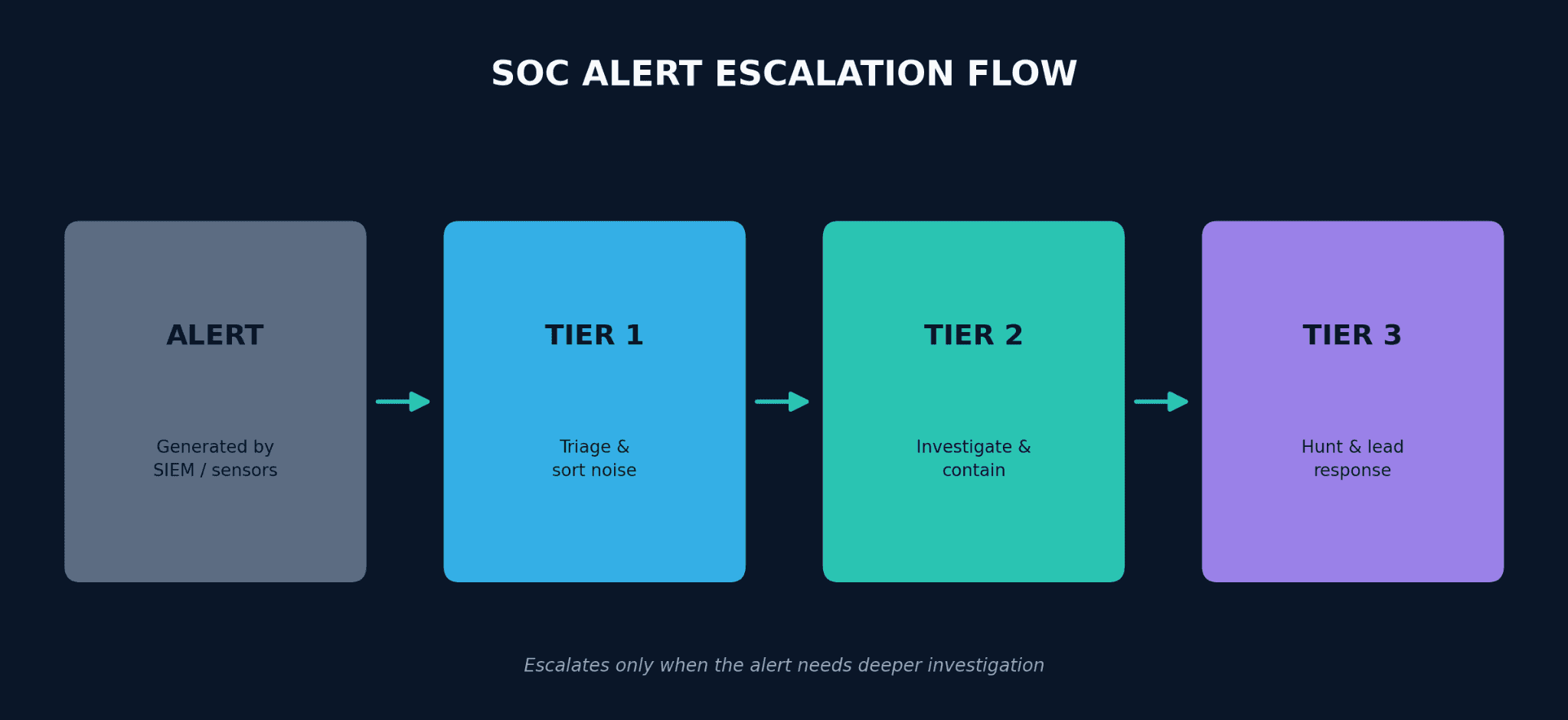
Most SOC teams are not flat. They split into levels called tiers. Each tier deals with a different kind of problem. A simple phishing email might stop at Tier 1. A live ransomware attack goes straight to Tier 3.
This guide explains what a Tier 1, Tier 2, and Tier 3 SOC analyst does. It also shows how the tiers differ. And it shows where AI fits in today.
If you want to compare tools instead of jobs, see what SOAR actually does inside a SOC.
What Is the SOC Tier Structure?
Picture a hospital emergency room. A triage nurse sees you first. A doctor sees you next. A surgeon steps in only if things get serious. A SOC works the same way. Each tier is one clear step in the path.
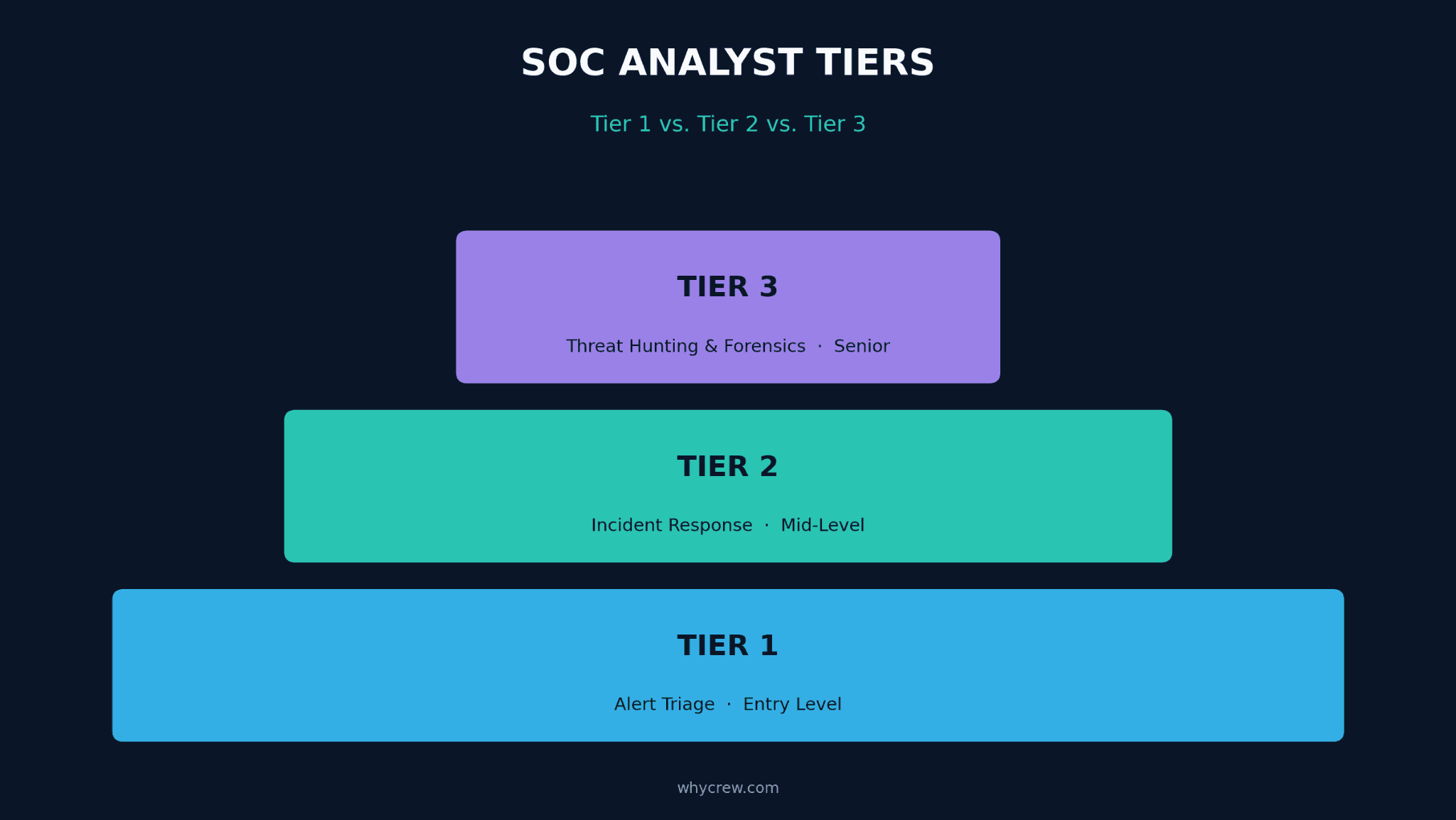
| Tier | Nickname | Main job | Skill level |
|---|---|---|---|
| Tier 1 | Alert Triage | Watch alerts, sort real threats from noise, send on what matters | Entry level |
| Tier 2 | Incident Responder | Look into alerts sent up, prove the threat, stop it | Mid-level |
| Tier 3 | Threat Hunter | Hunt hidden threats, run big incidents, fix defenses | Senior/expert |
Takeaway: almost every SOC uses this same three-step path. It works for a five-person team. It works for a 200-person MSSP floor too.
What Does a Tier 1 SOC Analyst Do?
A Tier 1 SOC analyst is the first person to see an alert. This is the entry-level job. It's where most people start in cybersecurity.
- Core task: Watch for alerts and sort them
- Handoff: Sends real threats up to Tier 2, with notes on what they found
- Common certifications: CompTIA Security+, CySA+
- Typical pay (US): about $55K-$85K a year
A Tier 1 shift is built around:
- Watching the alert queue as new alerts come in from the SIEM
- Checking each alert: is this normal, or worth a second look?
- Closing out false alarms most alerts turn out to be nothing
- Writing up real threats and sending them to Tier 2
- Following a fixed set of steps, called a playbook, for common alerts
The hard part of this job is not the threats. It's the sheer number of alerts. A mid-size company can get thousands of alerts a day. Almost all of them are noise. A Tier 1 analyst must move fast. They can't miss the one alert that matters.
This is also the tier with the most burnout. Staring at the same alerts for eight hours a day wears people down fast. This “alert fatigue” is a big reason SOC teams turn to automation here first.
Takeaway: Tier 1 is high-volume, rule-based work. That's why it's the easiest tier to help with better tools.
What Does a Tier 2 SOC Analyst Do?
So what's the difference between Tier 1 and Tier 2? Tier 1 sorts. Tier 2 digs in.
- Core task: Deep digging and stopping the threat
- Handoff: Sends hard or unsolved attacks up to Tier 3
- Common certifications: GCIH (GIAC Certified Incident Handler), CEH (Certified Ethical Hacker)
- Typical pay (US): about $85K-$130K a year
Once an alert is proven real, a Tier 2 SOC analyst takes over:
- Checking logs to see where the threat came from
- Proving whether it's a real incident, and how bad it is
- Starting containment: cutting off an infected machine, or shutting a bad account
- Leading a full response across every system it touched
- Handling alerts that don't fit a known pattern, ones Tier 1's playbook can't solve
In short, Tier 2 answers one question: “How bad is this, and how do we stop it right now?” This role needs more skill than Tier 1. It usually takes a year or more of hands-on work. It also takes a real feel for how attacks unfold, step by step.
Takeaway: Tier 2 turns a proven alert into a closed case. It's the step between “this is real” and “this is handled.”
What Does a Tier 3 SOC Analyst Do?
A Tier 3 SOC analyst holds the top role in the SOC. They do not wait for alerts. They go looking for trouble before it shows up on a screen.
- Core task: Hunt threats and run deep analysis
- Handoff: Leads the fix-up and hardening work after a big incident
- Common certifications: GCFA (GIAC Certified Forensic Analyst), GCIA (GIAC Certified Intrusion Analyst), OSCP (Offensive Security Certified Professional)
- Typical pay (US): about $130K-$180K a year, more for senior or principal roles
Core Tier 3 work includes:
- Threat hunting: searching the network for attackers who slipped past every rule and filter
- Leading the response to big incidents: breaches, ransomware, targeted attacks
- Digital forensics: figuring out exactly what happened, when, and how
- Building the detection rules that Tier 1 and Tier 2 rely on each day
- Acting as the top point of contact when no one else can solve it
Tier 3 analysts bring years of hands-on incident work. They also know how specific hacker groups and their tricks really work.
Takeaway: Tier 3 is where defense stops reacting and starts hunting. It hunts for threats Tier 1 and Tier 2 have not seen yet.
How Do Tier 1, Tier 2, and Tier 3 Compare?
Here is what Tier 1, Tier 2, and Tier 3 mean, side by side:
| Tier 1 | Tier 2 | Tier 3 | |
|---|---|---|---|
| Role | Alert triage | Incident response | Threat hunting & forensics |
| Handoff | Sends real threats to Tier 2 | Sends unsolved attacks to Tier 3 | Leads the fix; no tier above |
| Main question | Is this alert real? | How bad is it, and how do we stop it? | What did we miss? |
| Typical experience | 0-2 years | 1-4 years | 4+ years |
| Typical pay (US) | ~$55K-$85K | ~$85K-$130K | ~$130K-$180K+ |
| Works from | A fixed playbook | Playbook plus judgment | Deep digging, few fixed rules |
| Volume of work | Very high (hundreds a day) | Medium (proven cases only) | Low volume, high depth |
| Best fit for AI today | High, most repeat work | Medium, some steps work well | Low, needs human judgment |
Is Tier 1 or Tier 3 Better?
Neither is “better.” They are different jobs at different skill levels. This is not a ranking. Tier 1 is where most SOC careers start. Tier 3 is where that hands-on time leads, years later. If the real question is “which tier should a growing SOC fund first,” the answer is usually Tier 1. That's where alert volume piles up fastest. It's also where better tools pay off the most.
Where Does AI Actually Fit in the SOC Tiers?
AI is not replacing the tier setup. It's cutting down how much of Tier 1's work a human must do by hand.
- Tier 1: This is where AI helps the most today. Sorting and scoring alerts is repetitive, rule-based work exactly what AI is good at. AI steps in first, ahead of any human review. Cutting the noise here also eases the alert fatigue behind Tier 1 burnout.
- Tier 2: AI helps here too. It pulls logs, links events, and drafts a report. But a person still decides on the fix and next steps.
- Tier 3: Still almost fully human. Threat hunting and forensics need judgment and gut feel. AI can't fully match that yet.
In real use, AI-powered SOC automation has cut Tier-1 alert work by about 70-80%. The exact number depends on your alert volume and your current tools. See how AI SOC automation works for the full picture, or read why on-premise beats a cloud security copilot for how this runs fully inside your own infrastructure, with zero outside API calls.
Should AI fully replace a Tier-1 analyst? That's a different question. We answer it with real numbers in AI SOC Analyst vs. Traditional Tier-1 Analyst: What Actually Changes.
Takeaway: AI does the front-line work today (Tier 1). It helps in the middle (Tier 2). It stays hands-off at the back (Tier 3).
Frequently Asked Questions
A SOC analyst watches a company's systems and alerts. They catch and stop threats. The job splits into three tiers, based on skill and depth of work.
Alert volume and alert difficulty are two different problems. Splitting the work lets each tier focus. Tier 1 handles volume. Tier 2 handles proven cases. Tier 3 handles depth.
Neither. They are different jobs at different skill levels. Tier 1 is where SOC work begins. Tier 3 is where analysts land after years of hands-on response and hunting.
SOC threat intelligence is data on known attackers and their tricks. It helps spot threats faster. Tier 2 and Tier 3 use it most. Tier 2 uses it to prove and stop threats. Tier 3 uses it to hunt for ones no one has caught yet.
Pay varies by city, certifications, and employer, but typical US ranges are about $55K-$85K for Tier 1, $85K-$130K for Tier 2, and $130K-$180K or more for Tier 3, with senior and principal roles going higher still.
Tier 1 sorts alerts and clears false alarms. Tier 2 checks proven threats and stops them. Tier 3 hunts hidden threats and leads the response to big incidents.
About one to two years in Tier 1. Then two to three more years of hands-on response work before Tier 3. The exact time depends on team size and how much real incident work an analyst gets.
Not fully. AI takes over most of the repeat alert work. It scores alerts and clears noise. But a person still checks anything odd or high-risk before it closes.
Tier 1 analysts often hold CompTIA Security+ or CySA+. Tier 2 analysts often hold GCIH or CEH. Tier 3 analysts often hold GCFA, GCIA, or OSCP.