Quick answer
Is your Tier-1 team out of date? SOC leaders ask this question a lot this year.
No. Not yet. And not in the way most headlines say. In most SOCs, an AI SOC analyst sorts and cleans up alerts. It does not replace human investigation. It handles alert triage, log matching, and the first pass of sorting. It works faster than any human team.
A Tier-1 human still makes the hard calls. These are things like unclear situations, business risk, and anything that needs a phone call, not just a rulebook. In many SOCs, AI now handles about 70–80% of first-pass triage. The exact number depends on alert volume and tools. The human job is shifting too. Humans now watch and check the system, instead of touching every alert by hand.
Some vendors tell two different stories. One says, "AI is replacing SOC analysts." The other says, "AI can't be trusted with security decisions." Neither one is true for most SOCs. This isn't about replacing people. It's about splitting up the work. Which parts of Tier-1 work now go to a machine? Which parts still need a person?
Want the basics on SOC tiers first? Read our SOC tiers guide. This article picks up from there. It looks closely at the Tier-1 layer. That's where AI is showing up first.
What AI SOC Analyst Actually Means
An AI SOC analyst isn't just one thing. In real life, it's usually one of four setups. A copilot suggests actions to a human. An autonomous agent acts on its own, within set limits. A workflow-automation layer sorts and adds info to alerts. A triage engine sorts alerts and closes the easy ones. Most SOCs today use the last two.
A traditional Tier-1 analyst owns three jobs: sorting alerts, filtering out false alarms, and sending real threats up to Tier 2.
So the real question isn't AI versus human. It's about who does what. Which of those three jobs can a machine handle today? Which ones still need a person?
AI SOC Analyst Vs Tier-1 Analyst: At A Glance
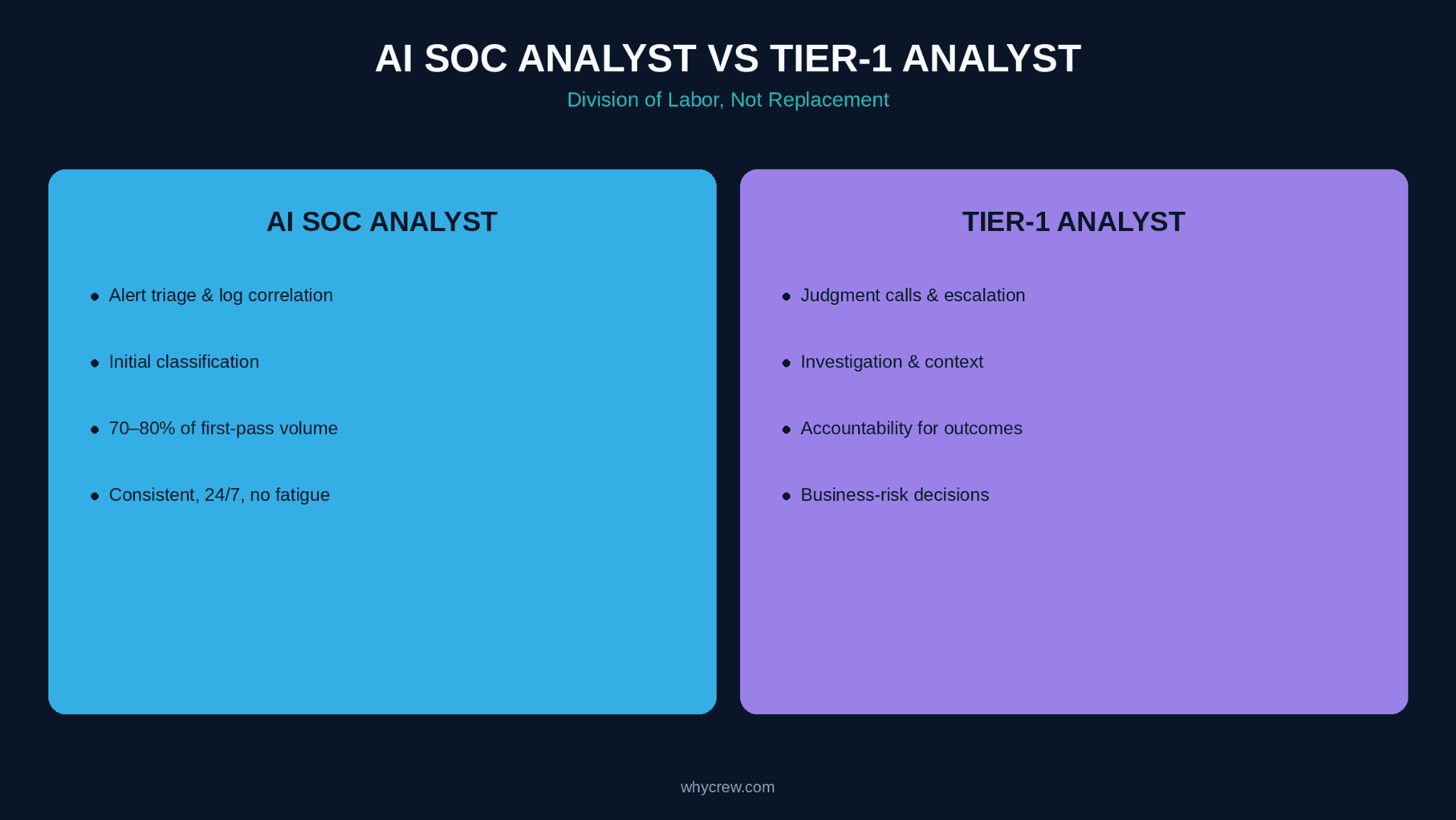
| Dimension | Traditional Tier-1 Analyst | AI SOC Analyst |
|---|---|---|
| Alert volume handled | Limited by shift hours and tiredness | Full volume, all day and night, no tired spells |
| Consistency | Changes by analyst, time of day, workload | Same logic, every time |
| Speed to first triage | Minutes to tens of minutes per alert | Seconds |
| Context and unclear cases | Strong: reads tone and unwritten context | Weak outside what it was trained on |
| Learning new attack patterns | Slow, but the skill carries to other systems | Fast within its scope, weak outside it |
| Accountability | One named person, clear reasoning | Needs a human to sign off on anything serious |
| Cost as you grow | Rises roughly in a straight line with alert volume | Stays fairly flat after the first build cost |
This table doesn't pick a winner. It shows that AI and a Tier-1 analyst do different jobs, even when people call both "Tier 1."
Will AI Replace SOC Analysts?
No. Not the whole SOC, and not any time soon. AI takes over the repetitive, high-volume part of the job. That means sorting alerts, matching logs, and closing the false alarms that fill up most of a Tier-1 queue. AI does not take over accountability, escalation judgment, or investigation work that spans systems that were never built to talk to each other.
This matters for how you staff your team, not just how you sell it. If a SOC removes its human Tier-1 layer completely, that isn't automation. That's a gamble. Someone still has to own the call when a model's "high confidence" turns out to be wrong. You can add AI on top of your current tools, or build it into an owned custom SOC platform. Either way changes the cost. It doesn't change that answer.
Where The Differences Actually Show Up
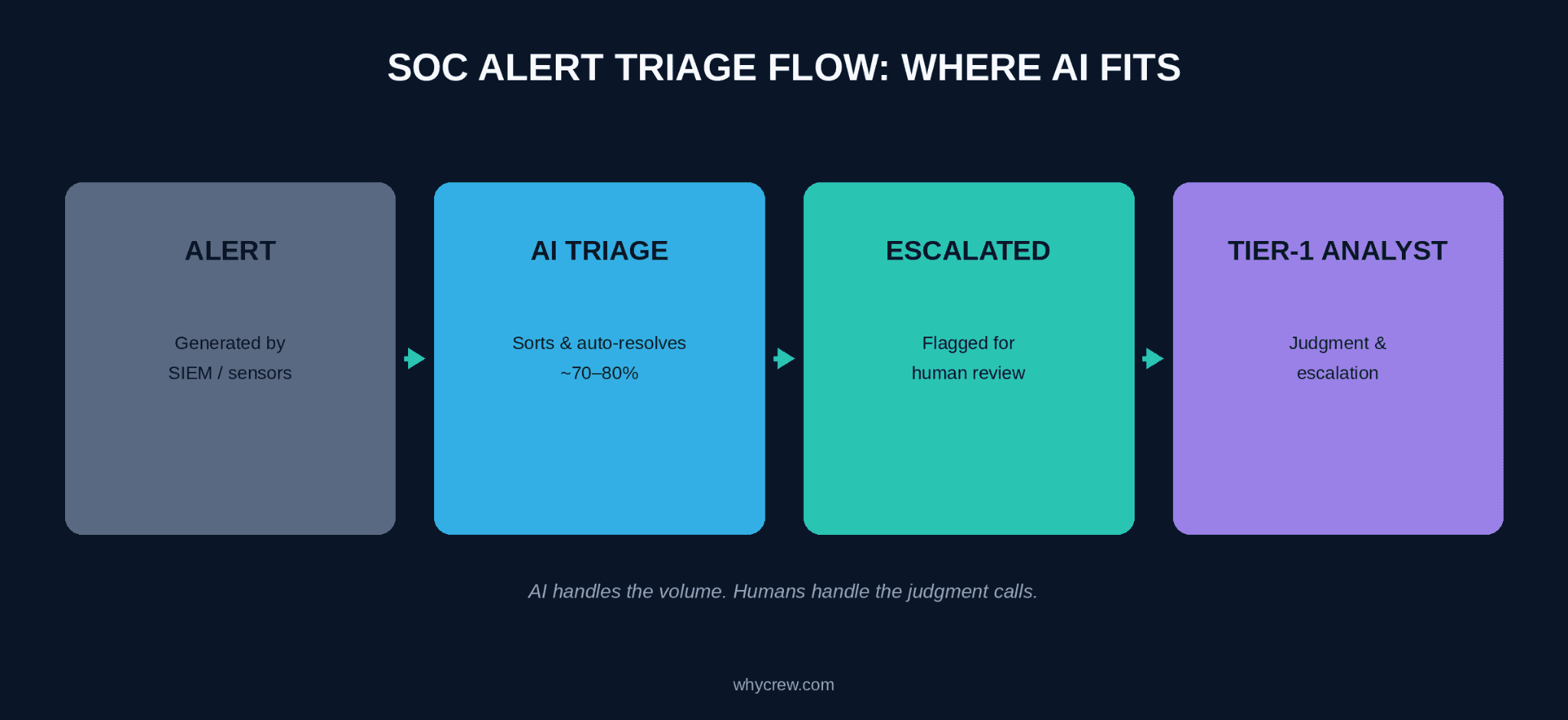
AI SOC Analyst Alert Triage Vs Human Analyst
A human Tier-1 analyst can sort a few hundred alerts in an eight-hour shift before quality starts to slip. And it does slip, especially by hour six of a night shift. An AI system doesn't have an hour six. Its accuracy stays the same all shift long. It uses the same logic on alert one and alert ten thousand.
That's the real gap: a SOC that only checks part of its alert queue, versus one that checks all of it. In practice, this kind of change often cuts manual triage work by up to 80%. It doesn't replace the analysts. It lets the system soak up the repeat first pass, so people stop drowning in duplicate, low-value alerts.
AI SOC Analyst False Positives
Does an AI SOC analyst cut down false positives? Usually yes, on the overall rate. But it changes what causes them, not just how many show up.
A human false alarm usually comes from tiredness, a distraction, or a log format they don't know well. An AI false alarm usually comes from a pattern that looks close to something in its training data. But it isn't the same thing at all.
Here's the catch: rates drop, but the false positives that slip through are harder to spot on a quick look. They don't look obviously wrong. They look like a normal alert that got sorted into the wrong bucket. That's why a human still needs to check the work. It can't just be a rubber stamp on whatever the model says.
AI Vs Human SOC Analyst Investigation
Triage is pattern matching. Does this look like something we've seen before? Investigation is a different job. It means following clues across systems that don't talk to each other. It means filling in gaps with judgment. It means knowing when a "clean" log isn't actually clean. Most AI SOC marketing skips over this difference.
AI is getting better at linking clues from a few sources. But it's not yet good at gut instinct, like when a Tier-2 analyst says, "this looks fine, but the timing bothers me," and turns out to be right. That instinct comes from years of hands-on work. No training set fully captures it.
Learning And Adaptation
A human analyst who sees a brand-new attack can reason it out from scratch, even with zero past examples. An AI system learns from patterns it has already seen. That makes it strong on things close to its training and weaker on truly new tricks.
This cuts both ways. Humans are slow to update as a group. What one analyst learns doesn't always reach the other eleven people on the team. Once an AI system's new skill is checked and approved, it spreads everywhere at once. So: slower learning for one person, faster learning for the whole team.
Escalation Judgment
Deciding when to escalate is often harder than deciding what to escalate. It takes a read on how much risk the business can handle, not just how bad the alert looks on paper. That's why this part of the job survives almost every wave of automation.
Cost And Scale Economics
A human-only Tier-1 team grows costs in a fairly straight line. Double your alert volume, and you're hiring roughly double the staff, plus training time, plus the burnout that comes with a really hard job. AI-powered SOC automation works on a different cost curve. It costs more to build up front, but the cost per extra alert flattens out fast. For an MSSP running many client accounts, that difference is the whole business case.
What Stays Human
Mostly, it's accountability. Someone has to explain, in a boardroom or to a regulator, why a call was made. "The model flagged it" isn't an answer anyone accepts once an incident hits the news. Most SOCs further along with AI still name one person in charge. That person owns anything that leaves the building: a customer notice, a regulator filing, a public statement. That's not a gap waiting to be automated away. It's a fixed part of the job.
The L1 Automation Ceiling: Classification Isn't Investigation
Classification is not investigation. Many "self-running SOC" vendors blur that line on purpose. It's the limit that matters most right now.
Classification asks one question: does this match a pattern we already know? That's a solved problem for most alert volume, which is why AI triage tools got good so fast. Investigation asks something harder. What actually happened? You have to look across systems that were never built to work together. Some evidence is missing. Some of it doesn't add up. That's not pattern matching. It's reasoning without all the facts. It's the part of the job that resists automation the most.
Trouble starts when teams expect AI to investigate the same way it triages. Treat AI as a triage layer. Give it a clear handoff to human judgment. Put that handoff at the same point where Tier 1 already hands off to Tier 2. Do that, and the automation ceiling stops causing problems.
What This Means For Your SOC
MSSP juggling client accounts on thin margins: the triage layer pays for itself the fastest. Your analysts are likely spending more time re-checking duplicate, low-value alerts across clients than doing real investigation. Fix that part first.
Regulated operator with audit needs: you need the accountability layer more than raw speed. Build or buy AI help that leaves a clear trail a regulator can follow. Avoid a black box that just says "high confidence" with no reason behind it.
Tier-1 team burning out and quitting every 9 to 12 months: that's usually an alert-volume problem, not a people problem. Automating the repeat work frees your remaining analysts for the judgment calls that make the job worth keeping.
FAQ
An AI SOC analyst handles alerts at machine speed, with no tired spells. A Tier-1 human brings context, business judgment, and accountability that a model can't yet supply.
No. Even the most advanced SOCs keep humans for escalation calls and anything that must be explained to a regulator or customer.
Usually, yes, but it changes the type. Human mistakes tend to come from tiredness. AI mistakes tend to come from close matches that only look real.
No, not fully. AI takes over the repeat triage work. But a person still has to own accountability, escalation calls, and investigation.
For common, high-volume alerts, yes, often as good as a tired human analyst. For new or unclear alerts, no.