Quick answer
An AI SOC, sometimes called an agentic SOC, is a security operations center where AI agents handle the alert lifecycle end to end. They read each alert, gather context, investigate, score risk, and either resolve the case or hand it off with the legwork done. It sits on top of the tools already in place, the SIEM and the EDR, rather than replacing them. One thing doesn't change: a person still owns the decisions that carry real consequences.
What Is an AI SOC?
A SOC watches an environment, catches threats, and responds before they cause damage. An AI SOC does the same job with AI agents; the "agentic AI" vendors talk about handling the repetitive front half of it instead of a human working a queue ticket by ticket. What that term actually means, and how it differs from generative AI, gets its own breakdown further down.
Most SOCs share the same three problems:
- Too many alerts. The overwhelming majority are noise.
- Too much manual work. A large share of any shift goes to gathering context, not deciding what to do with it.
- Not enough time. Attackers don't wait for a person to finish that digging.
An AI SOC is built to close all three gaps at once, not to add another layer of tooling that simply shifts the workload to a different queue.
AI SOC Tool vs. Platform vs. "AI in the SOC"
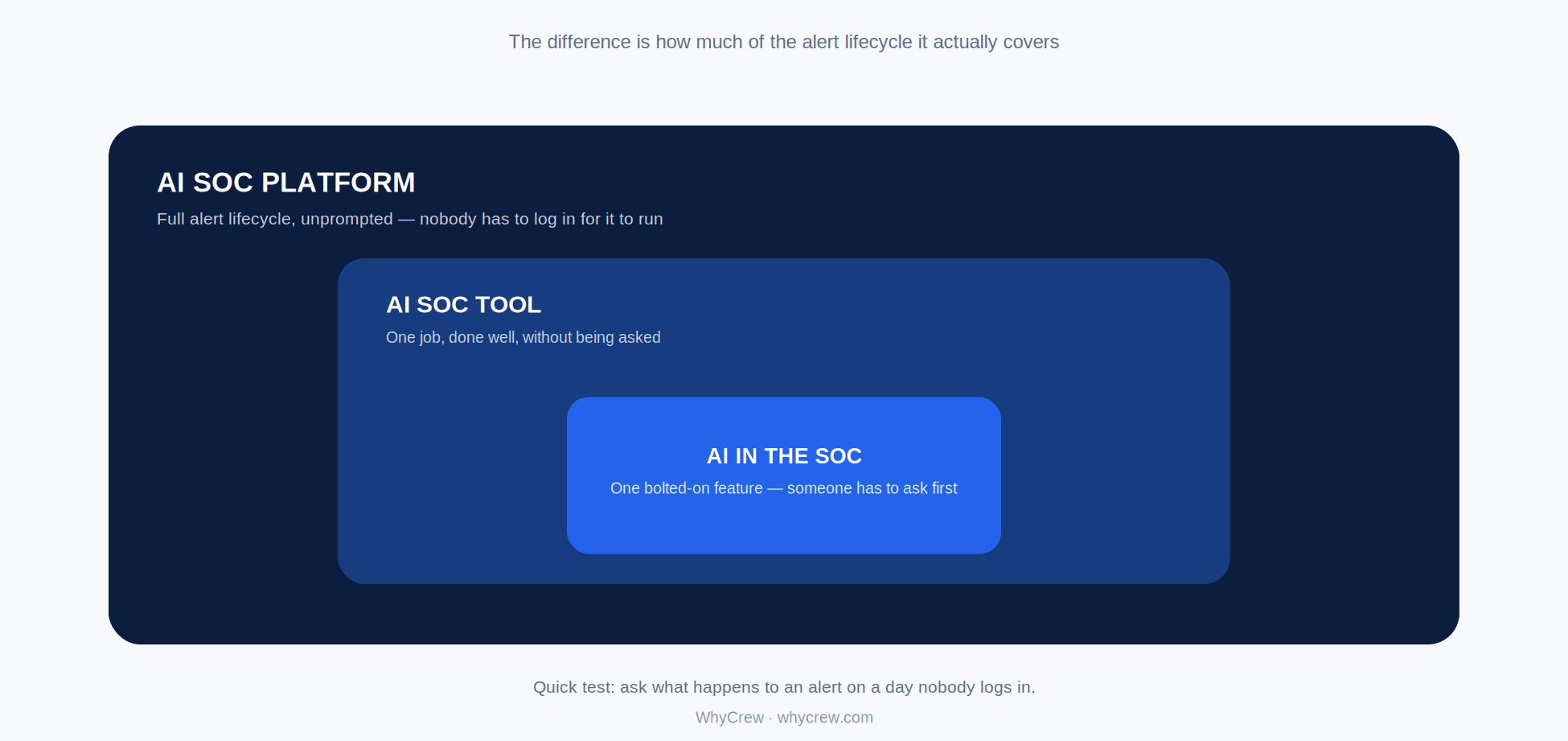
These three terms get used interchangeably in vendor marketing, which makes evaluating a purchase harder than it should be. The difference comes down to one question: does it wait to be asked, or does it act on its own?
| Term | AI in the SOC | AI SOC Tool | AI SOC Platform |
|---|---|---|---|
| What it is | A single AI feature added to an existing product | A purpose-built AI capability for one task | Multiple capabilities connected in one workflow |
| Who initiates the work? | A person, every time | A person, for that specific task | No one — it runs automatically on every alert |
| Scope | One feature within a larger tool | One task, executed well | The full alert lifecycle |
| Typical example | AI-assisted search or on-demand summarization | Automatic alert enrichment with context | End-to-end investigation, resolution, or escalation |
| When no one logs in | The alert sits untouched. | That one task runs; everything else waits | The alert is already investigated, closed, or escalated |
AI in the SOC is the most common thing sold under this label and the most passive. It waits to be asked. Someone has to query it before anything happens.
An AI SOC tool does one job without being asked, enriching an alert with context the moment it fires and nothing more.
A platform changes how the team operates. Triage, investigation, correlation, case management, and response run as one connected workflow on every alert automatically, without prompting. That's the standard the WhyCrew AI SOC Platform is built to.
A useful evaluation check: ask the vendor what happens to an alert when no one is actively monitoring the platform.
How AI SOC Agents Handle an Alert
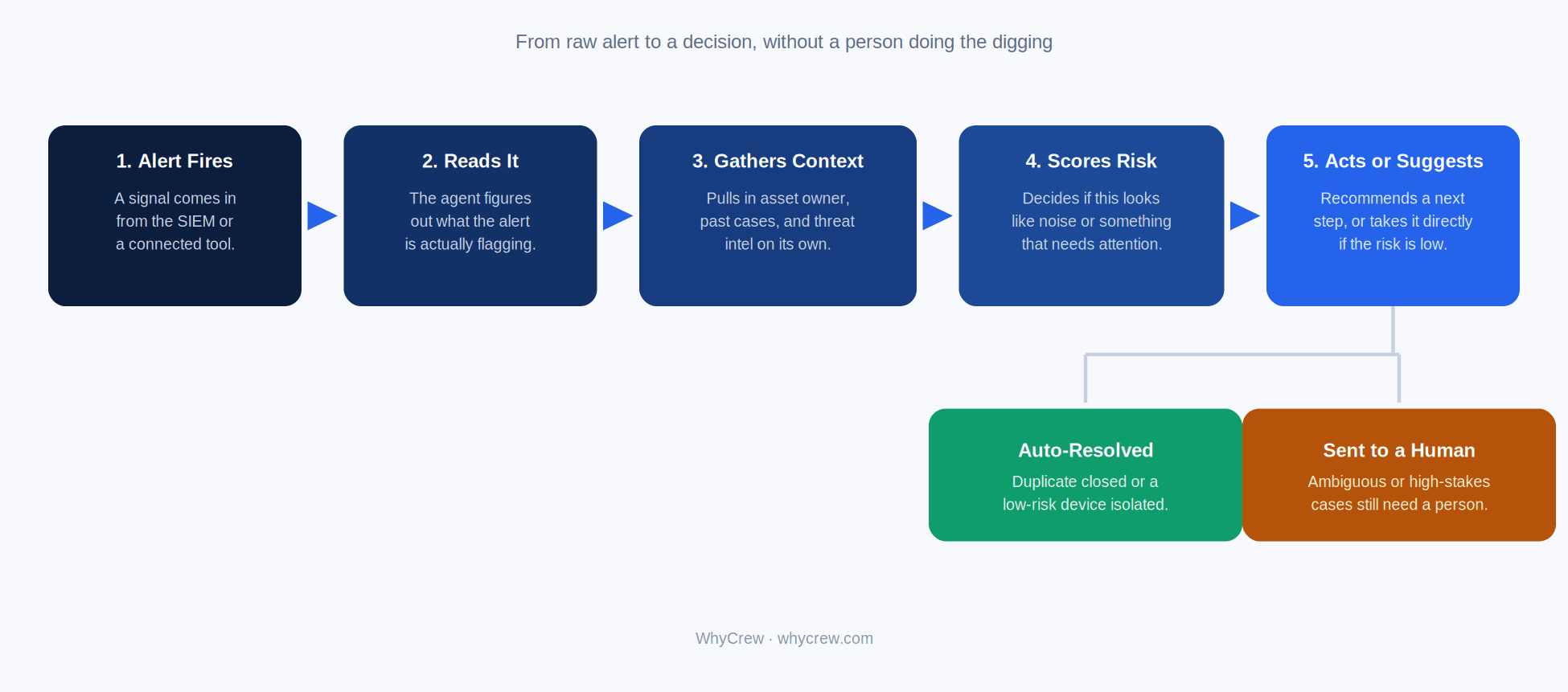
An AI SOC agent handles one security task on its own, using AI reasoning instead of a fixed script.
When an alert fires, the agent reads it, identifies what it's actually flagging, and pulls related context on its own asset ownership, identity signals, prior cases, and threat intel hits. It then reaches a verdict and shows the reasoning behind it, so someone can check its work later.
Some setups allow the agent to act directly: closing a duplicate, isolating a device, or revoking access. How far it can go without human approval is a configurable setting, covered in the autonomy levels section below.
When multiple agents operate across detection, investigation, and response in sequence, the result is a coordinated, automated workflow rather than a collection of isolated tools.
Key Capabilities of an AI SOC Platform
Most AI SOCs are built from the same six moving parts:
- Autonomous triage. Reviews and ranks a large volume of alerts in seconds, filtering out known-benign patterns and duplicates. This is what actually kills alert fatigue.
- Autonomous investigation. Gathers evidence and pulls data across tools that don't normally talk to each other. Reaches a defensible verdict on Tier-1 and Tier-2 alerts without a handoff.
- Agentic reasoning. The part that distinguishes this from older automation. Plans its own path and adapts as new evidence shows up mid-investigation.
- Rapid remediation. For clear-cut, low-risk cases: blocks traffic, isolates a device, and revokes access to all inside guardrails a person defined. Minutes, not hours.
- Ecosystem integration. Connects to SIEM, EDR, identity, and ticketing through existing integrations with no rebuild required.
- Escalation and human oversight. Anything ambiguous or high-stakes routes to a person for the final call, with the exact threshold set by whichever autonomy level is configured for that action type.
Types of AI in an AI SOC and What Each Term Actually Means
AI is a catch-all word in security marketing. Vendors stack similar-sounding terms on top of it: GenAI, AI agent, agentic AI, and multi-agent system until it's hard to tell what's actually different.
A real AI SOC is usually several distinct AI types layered together, not one model doing everything.
| Term | What it means | Where it shows up in an AI SOC |
|---|---|---|
| Supervised / unsupervised ML | Identifies patterns from historical data | Anomaly detection |
| UEBA | Builds behavioral baselines; flags deviations | Insider threat, compromised credentials |
| Natural language processing (NLP) | Reads and interprets unstructured text | Phishing email parsing, case notes |
| Generative AI (GenAI) | Produces text, summaries, or code from a prompt | Case summaries, incident write-ups |
| AI agent | Independently executes one specialized task | Alert enrichment, endpoint isolation, account lockout |
| Agentic AI | Plans and adapts a multi-step action sequence as evidence evolves | Investigation, triage, remediation |
| Multi-agent system (MAS) | Multiple specialized agents coordinating on a single case | Incidents spanning triage, investigation, and containment |
| Orchestrator agent | Directs which agent acts next and in what order | Sequencing multi-agent responses on complex cases |
These terms are easy to confuse, so here's a quick distinction between each.
Generative AI produces content because you asked it to. It doesn't decide anything on its own.
An AI agent is the smallest unit: one task, executed independently, without a person triggering it.
Agentic AI is the reasoning layer on top. It lets an agent plan a sequence of steps and adjust mid-task instead of following a fixed script.
A multi-agent system is what you get when several agents, each built for one job, work the same case together, with an orchestrator deciding who acts next.
A well-built AI SOC layers all of them: ML and UEBA for detection, AI agents and agentic reasoning for investigation and response, an orchestrator to coordinate the team, and generative AI for the write-up at the end.
AI SOC vs. Traditional SOC
| Term | Traditional SOC | AI SOC |
|---|---|---|
| Alert handling | An analyst opens each alert and checks several tools by hand. | The alert is scored, enriched, and correlated before anyone opens it |
| Context gathering | Pulled manually, console by console | Already attached: asset owner, history, threat intel |
| Where analyst time goes | Mostly collecting information | Mostly making the judgment call on flagged cases |
| Escalation path | Tier 1 to Tier 2 to Tier 3, each re-checking some of the same ground | Tier-1 work is largely pre-resolved; escalations arrive with a case file, not a raw alert |
| MTTD / MTTR | Typically hours | Typically minutes, for common alert types |
The scaling model is the real difference. A traditional SOC grows by hiring more people to do more manual digging. An AI SOC grows by automating the digging, so headcount tracks judgment calls instead of alert volume.
Autonomy Levels: How Much Control You Hand Over to the AI
Autonomy isn't on or off. It's a dial most organizations start low on and turn up as the system proves itself.
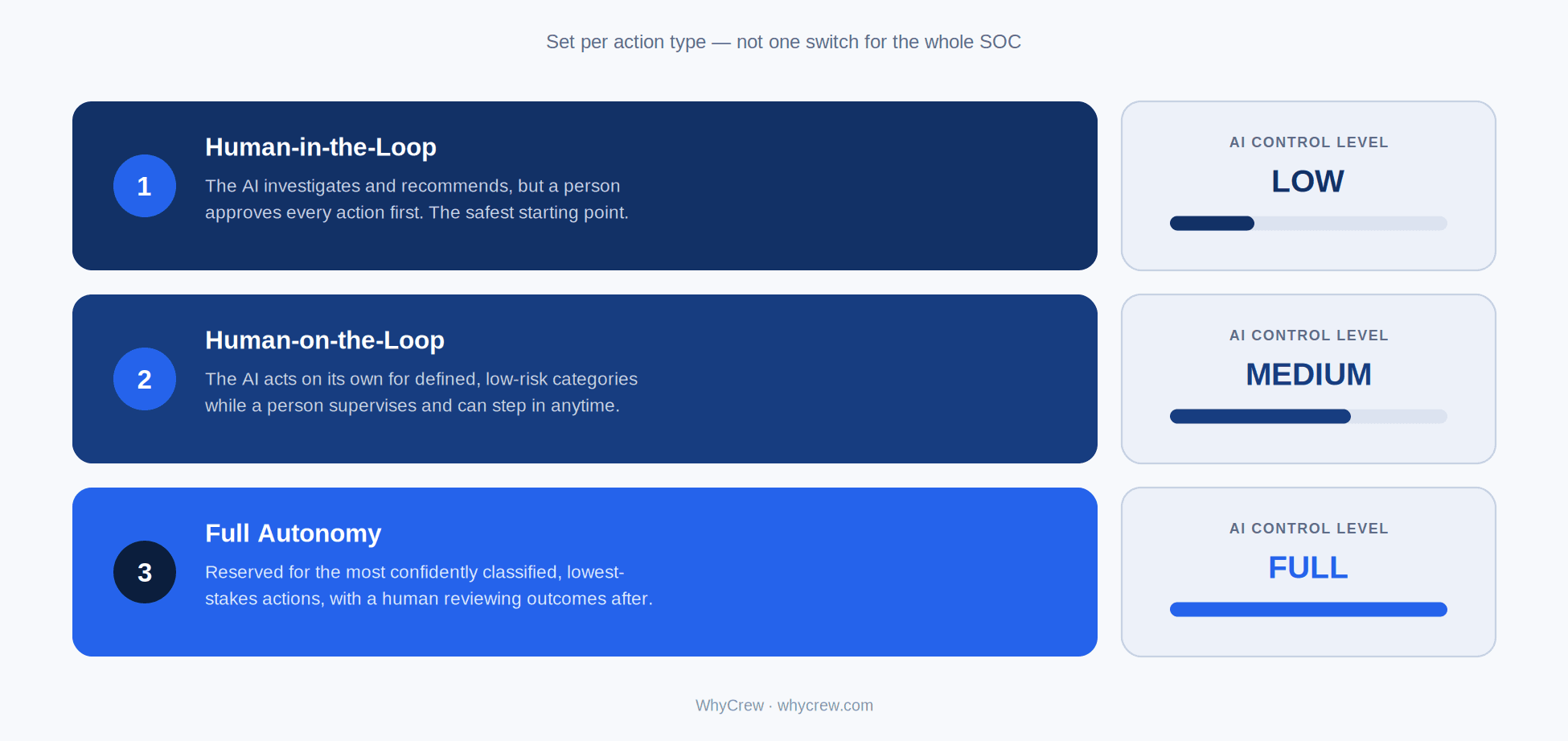
- Human-in-the-loop. The AI investigates and recommends, but a person approves every action first. The safest starting point.
- Human-on-the-loop. The AI acts on its own for defined, low-risk categories, isolating a device with a confirmed malware signature, for example, while a person supervises and can step in at any time.
- Full autonomy. Reserved for the most confidently classified, lowest-stakes actions, with a human reviewing outcomes after the fact.
The right setting depends on the specific action, not the organization as a whole. A team might run full autonomy on known-benign phishing reports while keeping every account lockout on human-in-the-loop. A vendor offering only one autonomy setting for everything is worth questioning.
Will AI Replace Human Analysts in the SOC?
No, and framing it as a replacement question misses the actual problem. Adopting AI in the SOC is about augmenting analysts, not eliminating them.
- The math doesn't support replacement. The industry is still short close to 4 million cybersecurity professionals worldwide, according to ISC2's workforce study. That gap is the reason to automate, not a headcount target to cut.
- AI reduces burnout. Offloading Tier-1 busywork and auto-resolving routine cases frees senior analysts for the threats and projects that actually need judgment.
- Humans stay the final decision-maker. A properly built AI SOC keeps a person in the loop for high-stakes calls. The AI does the evaluation and enrichment; the person still decides.
Adoption is still early. Gartner's 2025 Hype Cycle for Security Operations places AI SOC agents at the Innovation Trigger stage, with roughly 1% to 5% market adoption today exactly the profile of a category built to augment a stretched workforce, not one built to replace it.
AI SOC Architecture: The Five Layers That Make It Work
A well-built AI SOC comes down to five layers:
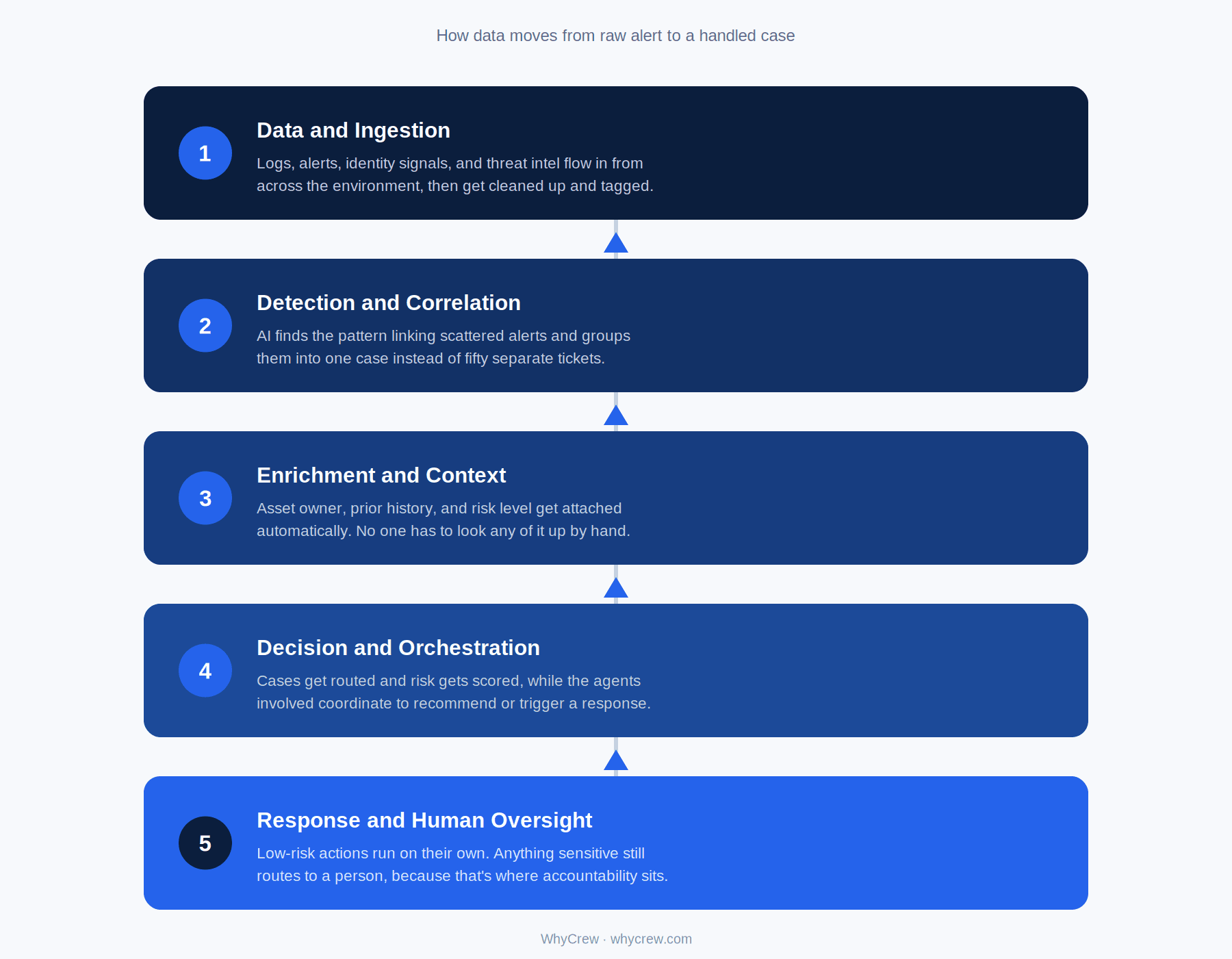
- Data and ingestion. Logs, alerts, identity signals, and threat intel flow in and get normalized so they're usable.
- Detection and correlation. AI groups scattered alerts into one case instead of dozens of tickets.
- Enrichment and context. Asset ownership, prior history, and risk level attach automatically.
- Decision and orchestration. Cases get routed and scored, and agents coordinate a response.
- Response and human oversight. Low-risk actions run on their own. Anything sensitive reaches a person.
SOAR vs. AI SOC: What Separates Playbook Automation from AI Reasoning
SOAR runs on playbook scripts written for situations someone already thought through. The moment something doesn't match, SOAR needs a human or a new script.
An AI SOC sits above that. It reads an alert nobody scripted for and works out a next step in real time, instead of stalling the moment reality doesn't match a pre-built playbook.
| Term | SOAR | AI SOC |
|---|---|---|
| Core method | Pre-built playbooks | AI reasoning plus automation |
| New situations | Needs a new script or a human | Adapts and generates a next step |
| Setup effort | Heavy upfront scripting | Lower ongoing effort |
| Triage | Executes fixed actions | Reads, investigates, recommends |
| Best fit | Repeatable workflows | Novel, evolving alerts |
These aren't rivals. Most mature setups use SOAR for predictable actions and an AI SOC for everything else.
Benefits of an AI SOC
- Faster detection and response. MTTD and MTTR commonly drop from hours to minutes, depending on alert type and autonomy level.
- Less burnout. Removing repetitive work is a consistently cited reason Tier-1 analysts and Tier-2 staff stick around longer.
- Better accuracy. Consistent enrichment means fewer real threats get buried under noise.
- Scalability. Alert volume can double or triple without a matching hiring spree.
- Fewer tools open at once. One enriched case replaces five dashboards.
Limitations and Risks of an AI SOC
- Hallucinations and prompt injection. LLMs can be manipulated through the data they're analyzing, like a phishing email's contents, so safeguards matter.
- Stale context. An agent working off outdated asset or identity records reaches confident, wrong conclusions.
- Trust and explainability. Analysts won't trust a verdict they can't see the reasoning behind.
- Compliance exposure. Feeding sensitive data through a model raises real questions in regulated industries.
- Accountability. Decisions with real legal or business weight still need someone accountable.
An AI SOC earns its keep when it's built around the environment's actual constraints, with someone watching model behavior over time.
Compliance and Audit Trails: What Regulators Need to See
Most vendor content skips this, and it's often the deciding factor for regulated organizations. An AI SOC needs a defensible audit trail: not just what action it took, but why. For organizations under NIS2, DORA, HIPAA, NCA ECC, SAMA CSF, or similar frameworks, that trail is often what a regulator asks to see. WhyCrew builds this into the platform for regulated organizations worldwide, from NIS2 and DORA compliance automation in the EU to NCA ECC and SAMA CSF compliance in Saudi Arabia.
Questions worth asking a vendor before signing:
- Can the system explain a verdict in terms a non-technical auditor could follow?
- Is there a clean record of every autonomous action, tied to the guardrail that permitted it?
- Does behavior on past case types stay consistent when the model updates?
How to Evaluate an AI SOC Vendor Before You Sign
- How does it reason? Get a walkthrough of a real investigation, not a slide. A relabeled rules engine usually can't show its evidence on demand.
- Who can take action, under what limits? Get specific about autonomy levels per action type, not a vague "human in the loop" claim.
- What's the integration story? A platform requiring a full SIEM or EDR rip-out is a bigger commitment than one that layers on through APIs.
- What's the pricing model on a bad day? Per-alert or per-endpoint pricing can produce a very different bill during an incident spike.
- What does the audit trail actually contain? Ask to see a real example.
If a product can't show its reasoning on a real case, or "autonomous" quietly means "pings a human who does everything manually, treat the AI SOC label with skepticism.
The AI SOC Maturity Model: Four Stages of Adoption
- Manual. Alerts triaged and investigated by hand, with SIEM and SOAR providing visibility, but no independent reasoning.
- Assisted. AI features exist inside individual tools, but a person initiates every investigation.
- Supervised autonomy. Agents investigate and act independently on defined, lower-risk categories.
- Fully agentic. Agents handle most of the alert lifecycle, and humans focus on strategy and the smaller set of high-stakes decisions.
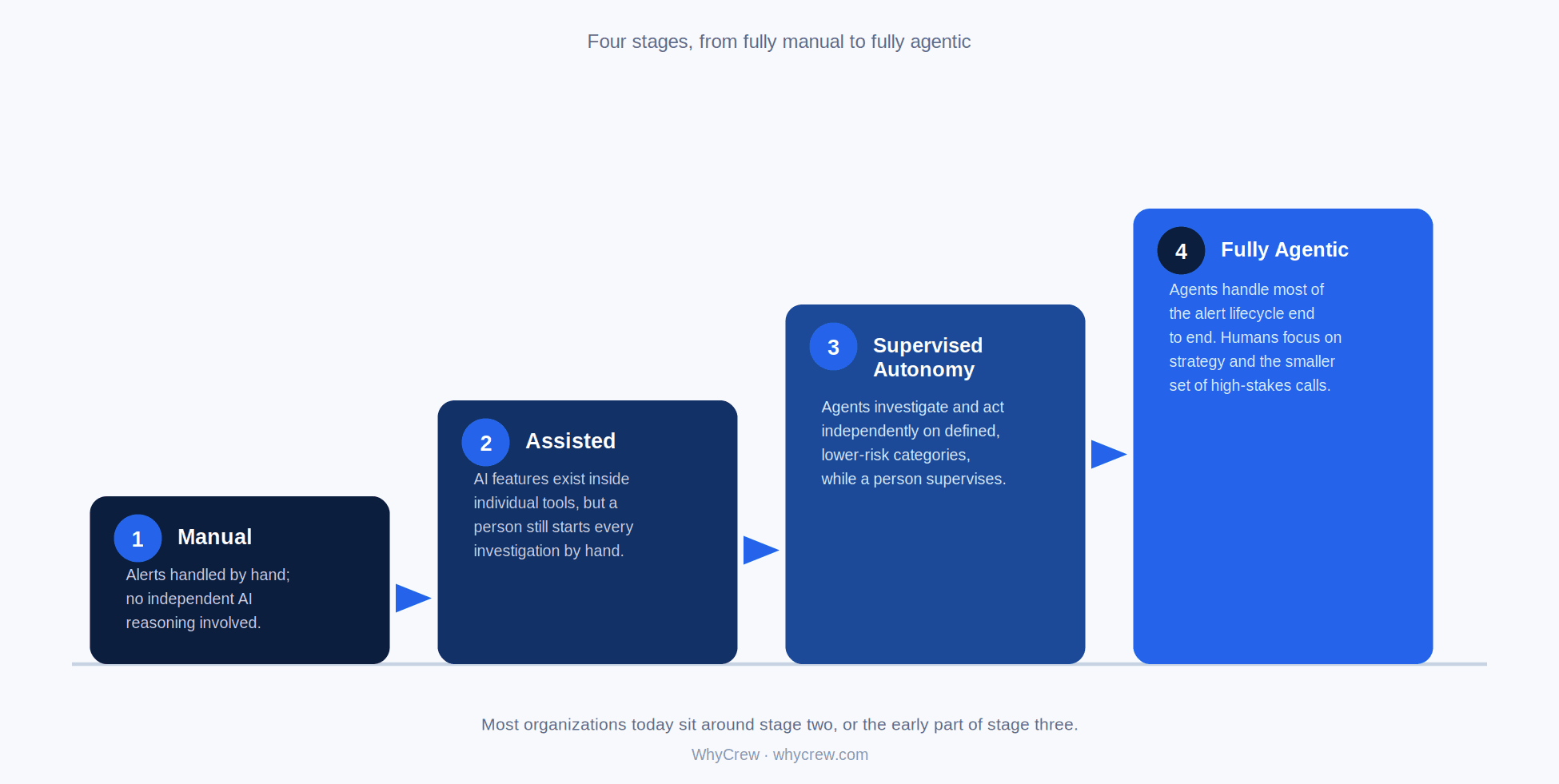
Most organizations today sit around stage two or the early part of stage three. This maturity model tracks how far the whole SOC has come; the autonomy levels covered earlier are the per-action dial you turn as you move through stages three and four.
Common Use Cases for an AI SOC
- Alert storms. When a scan, a misconfigured tool, or a false-positive rule floods the queue with thousands of near-identical alerts, the AI SOC groups and resolves the duplicates in minutes instead of a shift.
- Phishing investigation. The agent checks sender, links, and attachments against threat intelligence and reaches a verdict in seconds, instead of the ten or fifteen minutes a person would spend.
- Malware on an endpoint. The agent pulls the process tree, checks the file hash, and, depending on autonomy, isolates the device while packaging the investigation for later review.
- Threat hunting support. Surfaces slow-moving threats and lateral movement, spotted through behavioral and authentication anomalies, that a busy analyst would otherwise miss.
- MSSP operations, where one team covers dozens of client environments at once.
How WhyCrew Builds an AI SOC You Own and Control
WhyCrew builds the same core capabilities covered earlier triage, investigation, adaptive response, remediation, integration, escalation but changes where it runs and who owns it when the build is done.
- Zero external API calls. The models Llama 3, Mistral, or another open-weight model of your choice run entirely inside your own environment. This is the direct answer to the compliance-exposure risk raised earlier: sensitive data never reaches a third-party cloud in the first place, which is the deciding factor for MSSPs and regulated firms.
- You own the platform, not a subscription to it. No recurring AI licensing fees. Full source code, documentation, and training are handed over at the end of the build.
- Audit trails built for regulators worldwide, from day one. Every action is logged automatically in a format built for NIS2, DORA, and GDPR in the EU, and frameworks like NCA ECC and SAMA CSF elsewhere not retrofitted after a regulator asks a question.
- Results measured in production, not promised in a demo. A Netherlands-based MSSP that deployed the platform cut Tier-1 workload by 78%, hit a 12-minute average MTTR, and went live in seven weeks. A UK fintech client cut investigation time by 63% and now produces fully DORA-compliant reports automatically. Both case studies are covered in full on the AI-Powered SOC Automation page.
Is Your SOC Ready for AI Automation?
Wherever your SOC sits on the maturity model above, the rollout itself works the same way: start with whichever alert category costs the least to get wrong, and expand once it's proven out. WhyCrew's AI SOC automation readiness framework breaks that same climb into five practical, hands-on steps plus a reversibility test for deciding what to automate first. The right measure of success is movement in your operational metrics, not performance in a controlled demonstration.
Frequently Asked Questions
A security operations center where AI agents handle alert triage, investigation, and response automatically, so analysts spend their time deciding instead of digging.
"AI in the SOC" is one feature: a chatbot or search bar bolted onto a tool someone has to query. An AI SOC investigates every alert on its own.
Generative AI produces content in response to a prompt. Agentic AI plans a sequence of actions, executes them, checks the outcome, and adjusts.
No. It removes repetitive busywork while keeping a person accountable for anything that carries real risk.
SOAR runs playbooks scripted ahead of time. An AI SOC reasons through unfamiliar cases and adapts. Many teams run both together.
A well-built one logs the evidence and reasoning behind every action, producing an audit trail regulators can review, which matters most under frameworks like NIS2, DORA, or HIPAA.
Most organizations start on human-in-the-loop, then raise autonomy gradually on specific alert categories as trust builds.
Ask for a walkthrough of an actual investigation and specific autonomy limits per action type.
No. MSSPs and mid-sized teams often benefit the most, given their high alert-to-analyst ratio.
Usually not. Most platforms integrate with what's already running rather than requiring a replacement.