Quick Answer
AI SOC automation uses AI, including agentic AI that can reason, plan, and act, to run defined security operations tasks automatically. A stated trigger fires the task, and a person's rules and guardrails control it. It covers alert triage, evidence enrichment, event correlation, case creation, and a bounded set of response actions.
- What it automates well: high-volume, repetitive, reversible work such as triage, enrichment, correlation, and documentation
- What stays human: irreversible actions, business-risk calls, novel-threat investigation, and final accountability
- Where it fits: on top of your existing SIEM, EDR, and identity tools, not as a rip-and-replace
- How much it handles: in many deployments, AI absorbs a large share of first-pass triage, though the exact amount varies with alert volume, data quality, and tooling
The rule worth remembering: automate the context and the low-risk decisions first. Put a human gate on anything you can't easily undo.
What Is AI SOC Automation?
SOC automation replaces repeated analyst steps with rules and AI models. These models evaluate a trigger, take an action, and record why. Your security operations center keeps its people, tiers, and escalation paths. Automation absorbs the tasks analysts perform the same way across thousands of alerts.
A task counts as automated when the system does three things. It evaluates a trigger. A detection rule, a posture finding, or a schedule fires an event. It takes an action through an API. That might mean enriching an alert or opening a case. And it records the reasoning: what fired the rule, what it decided, and why.
That third step is easy to skip because nothing breaks right away. Its absence shows up later, in post-incident review. Treat it as non-negotiable.
How AI SOC Automation Goes Beyond Fixed Playbooks
Traditional automation runs fixed if-this-then-that logic that a person wrote in advance. AI SOC automation goes a step further. It uses machine learning and agentic AI to interpret ambiguous signals and reason across systems. Then it chooses the next approved action, within boundaries you define, instead of only running a pre-built decision tree.
What Role Does AI Play In SOC Automation?
This is the part buyers get wrong most often. AI doesn't replace the automation pipeline. It changes two specific layers of it: the decision layer and the investigation layer.
On the decision layer, older automation only runs the fixed rules someone already coded. AI weighs several signals together and reasons about alerts nobody wrote a specific rule for, then acts within the limits you've approved.
On the investigation layer, AI takes over the manual work of pulling context from several tools and assembling it into one timeline, instead of leaving an analyst to do that by hand for every alert.
What that looks like, task by task- triage, enrichment, correlation, and investigation write-ups- is covered in detail in the next section.
AI SOC Automation Vs. SIEM Vs. SOAR Vs. AI Copilot
These four get lumped together constantly, but they solve different problems.
| Category | Primary Job | How It Works | Strength | Common Gap |
|---|---|---|---|---|
| SIEM | Log collection and detection | Correlates logs using predefined rules and queries | Centralized visibility across your environment | Rule-heavy, high false positives, analyst-dependent |
| SOAR | Response automation | Executes fixed playbooks triggered by alerts | Fast, consistent repetitive response | Brittle when threats break the expected pattern |
| AI Copilot | Analyst assistance | Answers questions, summarizes alerts, suggests steps | Speeds up a human's work | A person still drives every investigation |
| AI SOC Automation | Autonomous investigation and bounded response | Reasons across evolving evidence, then acts within guardrails | End-to-end triage and investigation without static playbooks | Needs governance and mature data to deploy safely |
The short version: SIEM tells you something happened. SOAR runs the response you scripted for it. A copilot helps your analyst think faster. AI SOC automation figures out what the alert means. Then it takes the safe next step on its own.
Most modern SOCs run several of these together. AI-powered SOC automation usually sits on top of the SIEM and existing tools rather than replacing them. SOAR and agentic AI get confused for one another a lot, because both get called automation. The real difference is where the blast radius is decided. A SOAR playbook has its blast radius fixed in advance, by the person who wrote and tested it. Agentic AI has to work out the blast radius per alert, in real time, which is exactly why it needs the reversibility test that SOAR never had to ask for.
What AI Can And Can't Automate Today
Some SOC work is genuinely solved. Other parts of it are still unreliable no matter what a vendor's demo shows. Run either kind of work through the reversibility test below and the line between them gets a lot sharper than "repetitive versus judgment."
What AI Automates Well Today
Alert triage. High frequency, low blast radius. Closing out an obvious false positive costs almost nothing if AI gets it wrong, so it's a safe place to run at full autonomy.
Enrichment. Read-only by nature. Gathering identity, asset, geolocation, and threat-intel context doesn't change anything in your environment, which is exactly why it's worth automating first.
Correlation. Same logic as enrichment. Connecting scattered events into one incident doesn't act on anything. A wrong correlation gets caught on review, not lived with.
Investigation write-ups. The output is a draft a human reads, not an action that executes. Even a flawed write-up costs a few minutes of attention, not a rollback.
Compliance evidence collection. Scheduled, read-only, and low-stakes if it runs slightly wrong. It scores low on every axis of the reversibility test.
These share three traits. They're high-volume, they follow repeatable logic, and they're reversible or read-only.
What Still Needs A Human
Novel attack recognition. No prior pattern exists to score against, so the model is guessing under the same uncertainty a person faces, except a person can reason about intent and stakes.
Business-impact calls. Shutting down a production server is a simple action. The cost of being wrong is a business outcome, not a technical one. That's a blast-radius problem, not a complexity problem.
Irreversible actions. This is the reversibility test in its purest form. Revoking a key a live service depends on, or isolating a workload that's actively serving traffic, needs a human gate regardless of how confident the model is.
Cross-org response decisions. Customer notifications, regulator filings, and legal judgment calls extend the blast radius outside the SOC entirely. No automation should own that scope.
Accountability. Someone has to explain, in a boardroom or an audit, why a decision was made. A model can't answer for that, so the final call sits with a person even when the model did the work.
Classification Vs. Investigation
The distinction that matters most is classification versus investigation. Classifying an alert asks whether it matches something the system already understands. That part is largely solved. Investigation asks a harder question: what actually happened? Systems were never designed to be read together, and the evidence is often incomplete. That's reasoning under uncertainty. It's the part automation struggles with hardest.
A Reversibility Test For Every SOC Workflow
Most AI SOC guidance lands on a soft rule: automate the repetitive stuff, keep humans on the hard calls. That's directionally true, but it's not specific enough to act on when you're staring at one particular task and deciding whether to hand it off.
A sharper test works better. Before automating anything, weigh it against three questions.
How often does this happen? Frequency alone doesn't justify automation, but a low-frequency, high-variance task rarely earns back the engineering effort.
How reversible is the action? Adding context to an alert costs nothing to undo. Revoking a credential or isolating a production host does not.
What does a wrong call actually cost? Not in the abstract, in specific terms: an analyst redoing ten minutes of work, or a business-critical service going dark for an hour.
Score a task low-risk on all three, and it belongs in full automation. Score it high on even one, especially reversibility, and it needs a human gate no matter how confident the model is. This is the logic behind the tier breakdown, the workflow stages, and the governance table later in this guide. It's worth naming up front, because most automation decisions in a SOC reduce to these same three questions.
The Five-Stage AI SOC Automation Workflow
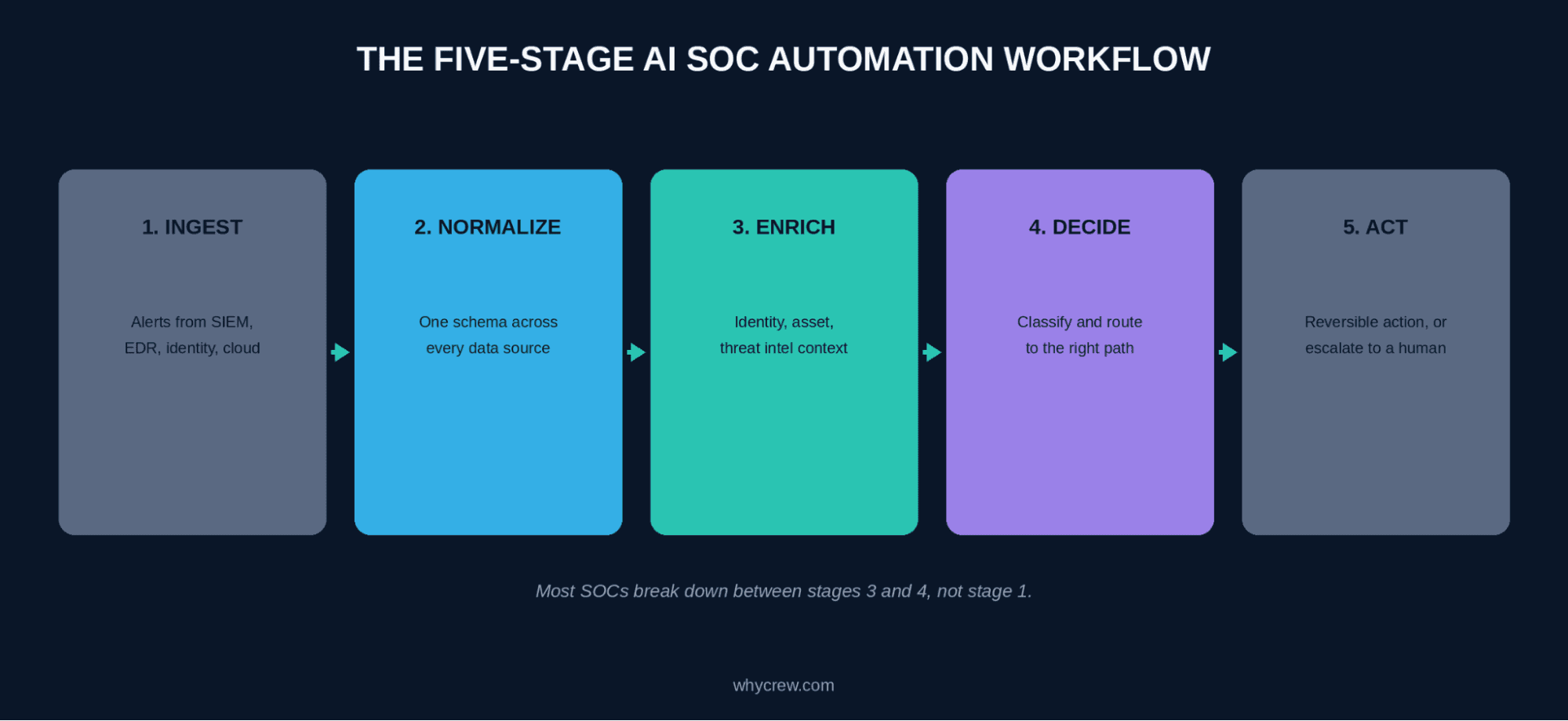
The reversibility test isn't only a filter for what to automate. It also sets the order alerts move through the pipeline. Every alert runs through the same five stages, and the earlier ones exist specifically to keep irreversible actions out of automated hands until the context justifies them.
| Stage | What Happens | Speed |
|---|---|---|
| 1. Ingest | Collect alerts from SIEM, EDR, identity, cloud, network, and SaaS sources | Real-time |
| 2. Normalize | Standardize different data formats into one schema | Seconds |
| 3. Enrich | Attach context: identity, asset criticality, reachability, behavior baselines, threat intel | Seconds |
| 4. Decide | Classify as true positive, false positive, needs deeper investigation, or needs human review | Fast |
| 5. Act | Execute a reversible action, or escalate with full context to a human | Varies |
That gap shows up directly in the numbers. The same Microsoft/Omdia study found 66 percent of SOCs lose a fifth of their week to manual aggregation and correlation. That's the exact work stages 2 and 3 exist to remove.
Most SOCs break down between stages 3 and 4. They collect and enrich alerts reasonably well. But the decision layer falls apart. A human can't hold fifteen data points in context across thousands of daily alerts. That's where AI earns its keep: pattern matching at scale, with memory across the whole environment.
Picture it with a real alert. An access key authenticates from a region your organization has never used. Enrichment answers four questions: who owns the key, what roles it can assume, what those roles can reach, and whether the account has ever behaved this way before. The decision weighs all four together. Geography alone should never carry it on its own. The action then does one of two things. It revokes the key, if that's safe and reversible in your environment, or it opens a case for a named owner. The analyst's final verdict feeds back to tell you whether that region signal deserved the weight it got.
An action taken on a thin alert is just a faster wrong decision. What the system can read about an alert matters more than how many actions it can fire. That's why enrichment is worth investing in first.
How To Automate Tier 1 And Tier 2 SOC Tasks
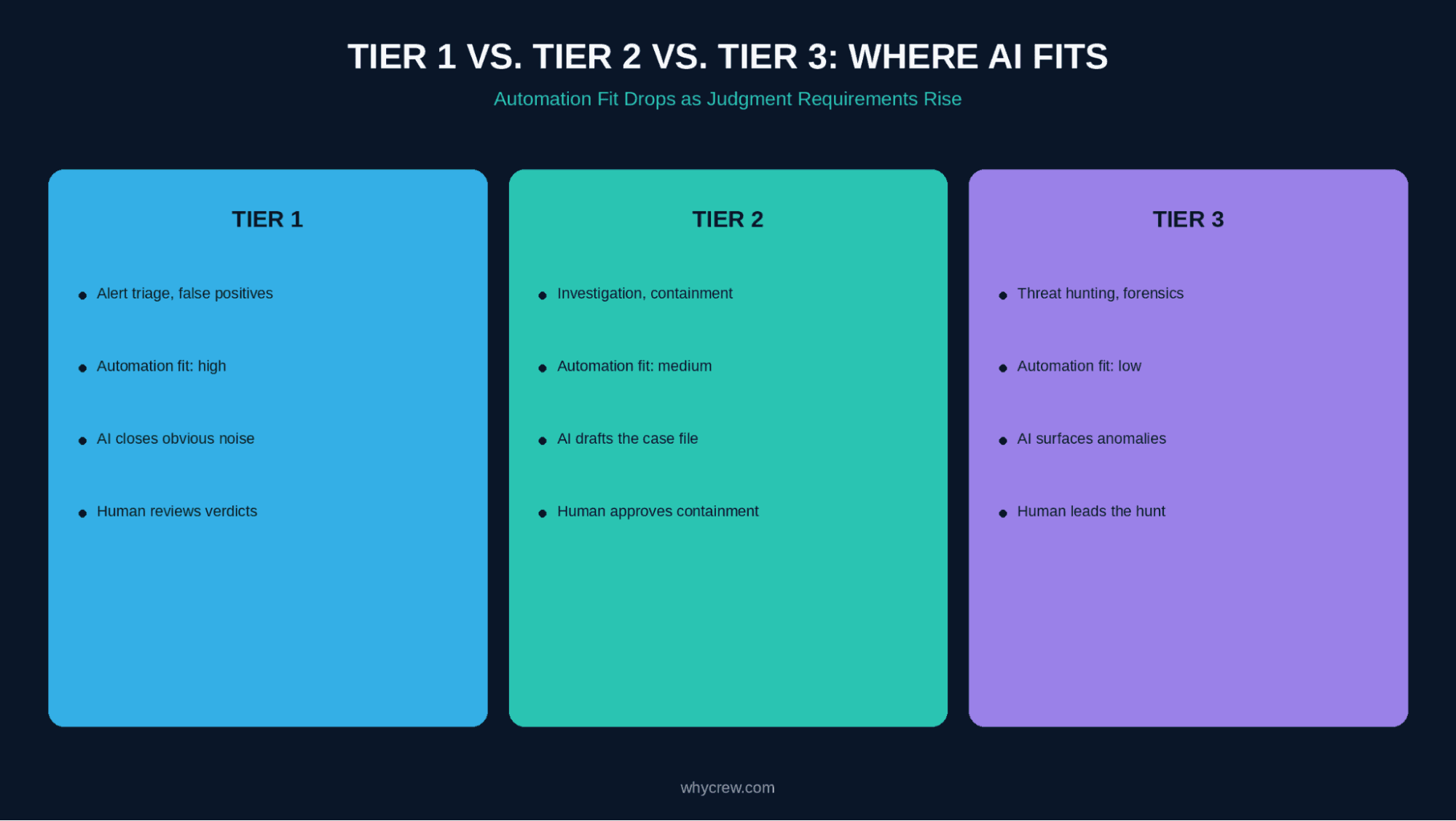
Different SOC tiers call for different automation strategies. Matching the automation level to the tier is where most of the practical value lives.
| Tier | Core Work | Automation Fit | What AI Does | What Stays Human |
|---|---|---|---|---|
| Tier 1 | Alert triage, false-positive filtering | High | Triages, scores, enriches, and closes obvious noise end to end | Reviewing verdicts, tuning priority for your environment |
| Tier 2 | Investigation, containment | Medium | Correlates events, builds timelines, drafts investigation reports, recommends next steps | Confirming severity, approving containment, handling novel patterns |
| Tier 3 | Threat hunting, forensics, detection engineering | Low | Surfaces anomalies, pulls hunt data at scale, assists rule tuning | Creative hunting, first-principles reasoning, major incident leadership |
Automating Tier 1
This is the clearest, most proven win. Tier 1 is high-volume and rule-heavy. That's exactly what drives burnout, and exactly what AI relieves first. Let AI investigate every alert the way a trained analyst would. Then hand the team a documented verdict to review, instead of a raw queue to grind through. For more on how this changes the Tier 1 analyst's day-to-day role, see AI SOC analyst vs. traditional Tier-1 analyst.
Automating Tier 2
Here AI assists rather than runs the show. It pulls logs, correlates events, and drafts an investigation summary. But a human still owns the containment decision, and the judgment call on how bad a situation actually is. Draw the automation handoff at the same place your Tier 1-to-Tier 2 handoff already sits. The transition then feels natural rather than forced.
Take a service account that's been dormant for months and suddenly assumes a privileged cloud role it has never used before. AI checks when the account last authenticated, what the new role can reach, and whether a scheduled deployment or maintenance window explains the change. If nothing explains it, the case names the exact resources now in scope and flags the account for immediate review, since an unexplained privilege jump is exactly the kind of high-blast-radius event the reversibility test flags. If a deployment window does explain it, the case closes itself with the evidence attached. A Tier 2 analyst reads that in under a minute, instead of pulling role-assumption logs, deployment calendars, and account history by hand.
Where Tier 3 Stays Human
Threat hunting and forensics stay almost entirely human. AI is a useful research assistant here. It gathers and enriches data at machine scale, but the creative direction and the deep reasoning belong to your senior people.
Highest-ROI Use Cases For AI SOC Automation
Not all automation pays off equally. The most common mistake is trying to automate everything at once, instead of starting where the return is disproportionate.
- Alert triage and prioritization. The single largest time-sink in the SOC. Most of it is pattern matching against known-good baselines. A Microsoft-commissioned Omdia study of 300 security professionals found 46 percent of alerts turn out to be false positives. Another 42 percent go uninvestigated entirely (Microsoft Security, February 2026). Every minute saved on a false positive is a minute an analyst spends on a real threat instead.
- Phishing investigation. A frequent, well-understood incident type. AI can analyze headers, detonate URLs in a sandbox, and assemble the verdict fast.
- Threat intelligence enrichment. Manual IOC lookups across many feeds are a solved problem. Automating multi-source enrichment gives analysts hours back directly.
- Incident response and containment, with gates. Auto-orchestrate the reversible steps, but keep a human approval gate on high-impact actions. A system isolating a clearly compromised endpoint at 3 a.m. is useful. A system shutting down a production database on its own is a liability.
- Compliance evidence collection. Board-visible, audit-critical, and immediately time-saving. It collects control artifacts on a schedule, without touching production state.
How To Choose An AI SOC Platform: Evaluation Criteria
Choosing a platform on feature lists and vendor demos tends to end in regret. These are the questions worth bringing into every proof of concept.
Investigation depth. Does it actually investigate, or just enrich alerts and stop? Can it produce a human-readable reasoning chain for every decision? Does accuracy hold up against your own alert samples, including your custom detections and unusual infrastructure?
Autonomy and reversibility. Does the platform distinguish reversible from irreversible actions? Or does it treat "add a note" and "detach an IAM policy" as the same class of step? Does the autonomy model match your risk tolerance, with configurable boundaries rather than a binary switch? Do guardrails reliably block out-of-scope actions and privilege escalation?
Context and integration. What can it read without a custom connector? Integration lists usually count action destinations. But what it can read matters more, since that's what enrichment runs on. Analysts at the average organization already pivot across 10.9 separate consoles to investigate a single alert (Microsoft Security, February 2026). A platform that adds an eleventh screen, instead of reading from the ones you have, is solving the wrong problem. Does it work on top of your existing stack without forcing a rip-and-replace? What happens when an enrichment source times out: does it proceed with partial context, retry, or stop?
Governance and cost. Are audit trails real-time, complete, and exportable in a format your compliance team can use? Do human-in-the-loop gates trigger at the right decision points and route to the right people? Is total cost of ownership predictable as alert volume and agent deployments grow?
Teams weighing whether to buy a platform outright, or build automation into their existing custom SIEM and SOAR stack, usually land on the same answer. The evaluation criteria above matter more than which path gets you there.
Governance, Auditability, And Human-In-The-Loop Boundaries
An AI SOC that can't prove what it did and why to an auditor creates as much risk as it removes. Governance isn't something bolted on afterward. It's the foundation that decides whether automation protects you or creates new liability.
Three failure modes are worth planning for.
Automated response to a false positive. AI isolating a production server on a misclassified alert can cause more damage than the original threat. Confidence thresholds and human approval gates for high-impact actions guard against that.
AI hallucinations in investigation summaries. A model can fabricate an indicator or invent a log entry that never existed. Every output needs grounding in raw evidence, with source citations and analyst verification.
Liability of autonomous actions. If AI revokes a VIP's credentials on a false positive during a board meeting, someone has to own that. That means documented policies, named rule approvers, and complete audit trails.
Set The Bar On The Action, Not The Confidence Score
A confidence score tells you how strongly a model supports its output. It says nothing about the blast radius of the action attached to it. Even a well-calibrated 0.95 still allows errors. Set the approval bar on the action's reversibility instead of the model's confidence. An irreversible step needs a reason a person can read, a named owner, and a rollback path. That holds whatever the score says.
The Reversibility Line For Autonomy
This table is the reversibility test applied to a real SOC action list, ranked from lowest blast radius to highest.
| Action | Risk Level | Governance Requirement |
|---|---|---|
| Enrich and correlate alerts | Low | Fully autonomous, logged |
| Auto-close known false positives | Low | Autonomous once validated, logged |
| Create and route a case | Low | Autonomous, logged |
| User verification via chat | Medium | AI-initiated, human-confirmed |
| Suppress a documented exception | Medium | Requires named owner and expiry |
| Endpoint isolation | High | Human approval required |
| Credential revocation | High | Human approval, documented justification |
| Network segment quarantine | Critical | Senior approval, incident bridge |
Read the table bottom to top, and the pattern holds. The harder something is to undo, the more human judgment it needs before it runs.
Recognized frameworks reinforce this instinct too. NIST's incident-response guidance still calls for manual review where automation can't reach. The EU AI Act's human-oversight expectations point in the same direction for high-impact automated actions.
A Phased Implementation Roadmap
Trust is earned through measured accuracy, not vendor promises. Don't flip from fully manual to fully autonomous overnight.
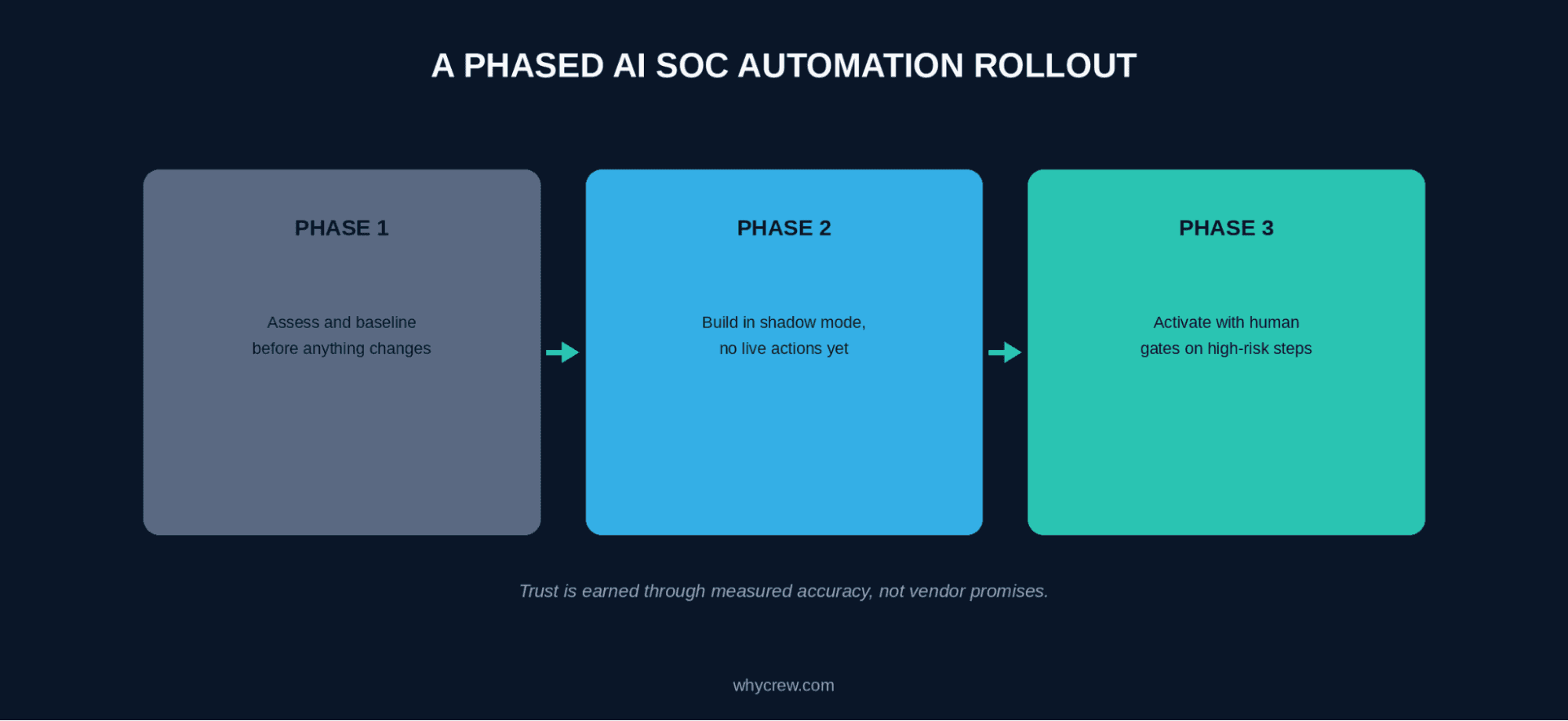
Phase 1: Assess And Baseline
Audit the current stack across SIEM, EDR, identity, cloud, and network tools. Map alert volumes by source, category, and disposition. Establish baselines for mean time to detect, mean time to respond, false-positive rate, and analyst hours spent on triage. Define governance up front: which actions auto-execute, and which require human approval. Document these numbers before anything changes. There's no way to prove ROI later without a "before."
Phase 2: Build And Configure
Deploy in shadow mode on a single high-noise category. Identity anomalies or phishing work well. Log what the system would have done, without letting it act. Integrate priority data sources first (endpoint, identity, email), then cloud and network. Begin detection tuning against the human baseline and expect a few weeks of calibration. Sequence the rollout using the same reversibility test that decided what to automate in the first place. Start with enrichment, since it changes no state. Move to correlation and case creation next, since both are auditable after the fact. Add reversible containment last, once the approval bar is written down.
Phase 3: Activate And Measure
Transition to live triage with analyst oversight. Then expand to full alert coverage as trust builds. Enable reversible containment while keeping human gates on high-risk actions. Turn on compliance evidence generation mapped to your controls. Instrument the automation itself by counting what each rule fired on and how often an analyst reversed it.
Common Pitfalls To Avoid
Turning on every category in week one, rather than picking one and expanding weekly. Skipping governance instead of defining approval gates before deployment. Treating tuning as one-and-done instead of scheduling weekly calibration reviews. Not measuring baselines. That leaves no way to prove value later.
Where To Start With AI SOC Automation
If your Tier 1 team is drowning in alerts, start with alert triage automation. It's the highest-volume, lowest-complexity, biggest-payoff place to begin. Run it in shadow mode first. Prove the accuracy against your own alerts, then go live.
If you're a lean or mid-market team without a large SOC, automate in this order: alert triage, then phishing response, then compliance evidence collection. These three give coverage and board-visible results without needing a large engineering team.
If you're a regulated operator with audit obligations, prioritize the accountability and auditability layer over raw speed. Insist on auditable reasoning trails and source-cited investigations. Don't settle for a black box that says "high confidence" with nothing behind it.
If you're an MSSP juggling many client environments, the triage layer pays for itself fastest. Analysts are almost certainly re-processing duplicate, low-fidelity alerts across clients, instead of doing real investigation. Fix that first.
The pattern across all four start with what AI can already prove it does well, and add a human checkpoint wherever a mistake would be hard to walk back.
Frequently Asked Questions
AI SOC automation uses artificial intelligence, including agentic AI, to run security operations tasks automatically. That includes alert triage, enrichment, correlation, and bounded response, under rules and guardrails a person controls.
AI upgrades the decision and investigation layers of the automation pipeline. That means classifying alerts using context, correlating events into incidents, drafting investigation write-ups, and recommending or executing low-risk actions.
SOAR runs fixed if-then playbooks that only handle scenarios someone coded for in advance. AI SOC automation reasons across evolving evidence and acts within guardrails. It doesn't need a pre-built playbook for every case.
No. AI replaces the repetitive parts of the job, triage, enrichment, correlation, false-positive closure. Accountability, escalation judgment, novel-threat investigation, and irreversible decisions still need a person. Someone who can be held responsible.
Automate Tier 1 triage first, since it's high-volume and reversible. For Tier 2, use AI to assist by correlating events and drafting reports, while a human approves containment.
Yes. Modern AI SOC platforms are designed to layer on top of tools like Splunk, Microsoft Sentinel, or Elastic rather than replace them. The question worth asking a vendor is whether their platform integrates with your stack or forces you to rebuild it.
Investigation depth, explainable reasoning for every action, whether it distinguishes reversible from irreversible actions, what it can read without custom connectors, and whether its audit trails satisfy your compliance needs.
There is no single number that applies to every environment. Alert mix, data quality, and how mature your detection rules are all change the outcome. Run a 30-day proof of concept against your own alert volume before you trust any vendor's published percentage, and track the false-positive rate alongside the automation rate so you can see what the tool is actually closing correctly.