Quick answer
SOC analyst burnout is what happens when the Tier-1 job itself is set up badly: too many alerts with no context, too many separate tools, and no growth path. It's not simply a case of too few people. It shows up first as fatigue, mistakes, and disengagement, then as analysts quitting. Along the way, it slows down how fast real threats get caught and stopped. The fix isn't more headcount. It's redesigning the workflow: cut alert noise at the source, automate the manual context-gathering, and give analysts a visible path forward.
What Is Tier-1 Alert Fatigue?
Tier-1 alert fatigue is mental exhaustion and desensitization. It builds up when analysts see too many repeat, low-value, or false alerts. This isn't normal job stress. It's a specific reaction to a specific pattern: hundreds of near-identical alerts a day, most of which turn out to be noise.
That imbalance is the core problem: a high noise-to-signal ratio where the alerts worth acting on are a small fraction of the total volume. There's no easy way to know which ones matter until they're all checked. You'll hear this called by several names: SOC alert fatigue, cybersecurity alert fatigue, alert overload, security fatigue, false positive fatigue, or security analyst burnout. It's the same underlying problem, whether it's described broadly across a whole team or narrowed down to the Tier-1-specific version this article focuses on.
Left alone, that noise causes two problems. First, it buries the few real threats (IOCs) inside a much bigger pile of background noise. Second, it wears analysts down until they quit.
This pattern is well known across the security industry. Burnout is common among Tier-1 analysts. Many say they're thinking about leaving. Manual, repetitive tasks eat up most of a typical shift. The details vary by source, but the pattern holds: worn-down analysts who are thinking about quitting are the norm at short-staffed, under-tooled SOCs. Not the exception.
Warning Signs of Tier-1 Burnout
Catching burnout early is far easier than fixing it after someone has already updated their resume. A few signs tend to show up before an analyst actually quits:
- Physical exhaustion. Persistent fatigue, more frequent illness, headaches, or trouble sleeping. These are the signs of rotating shifts and constant alert pressure showing up in the body before they show up in performance.
- Rising missed or misclassified alerts, especially ones that should have been easy calls for that analyst.
- Rubber-stamped escalations sent to Tier-2 without real investigation behind them.
- Skipped context-gathering steps an analyst used to follow closely, now done halfway or not at all.
- More sick days, late arrivals, or last-minute shift swaps than usual for that person.
- Visible cynicism about the work: jokes about "just closing tickets," going quiet in team meetings, or checked-out body language during handoffs.
- Questions about other teams, other roles, or other companies, even in casual conversation.
- Slower response times on the kinds of cases that used to move quickly for that analyst.
- Errors or near-misses caught by someone else, not self-reported. These often show up as a slow, creeping rise in mean time to respond (MTTR) for that analyst's cases, not just as one-off mistakes.
None of these alone means someone is burning out. Everyone has an off week. But two or three showing up together, in the same person, over a few weeks, is worth a direct conversation before it becomes an exit interview.
Why Tier-1 Attrition Is a Structural Problem, Not a Staffing Problem
When Tier-1 turnover rises, the first instinct is to hire faster. That treats the symptom, not the cause. A new analyst gets the same alert queue. The same manual work. The same lack of growth. They'll burn out on the same timeline as the person before them. Hiring alone won't fix SOC retention, analyst retention, or security team turnover.
Part of the problem is how Tier-1 gets defined. As we explained in SOC Analyst Tiers Explained: Tier 1 vs. Tier 2 vs. Tier 3, Tier 1 should filter noise before it reaches senior analysts. It shouldn't be a dead-end job with no ceiling. When that filter isn't built well, all the extra volume lands on whoever is sitting in the Tier-1 seat.
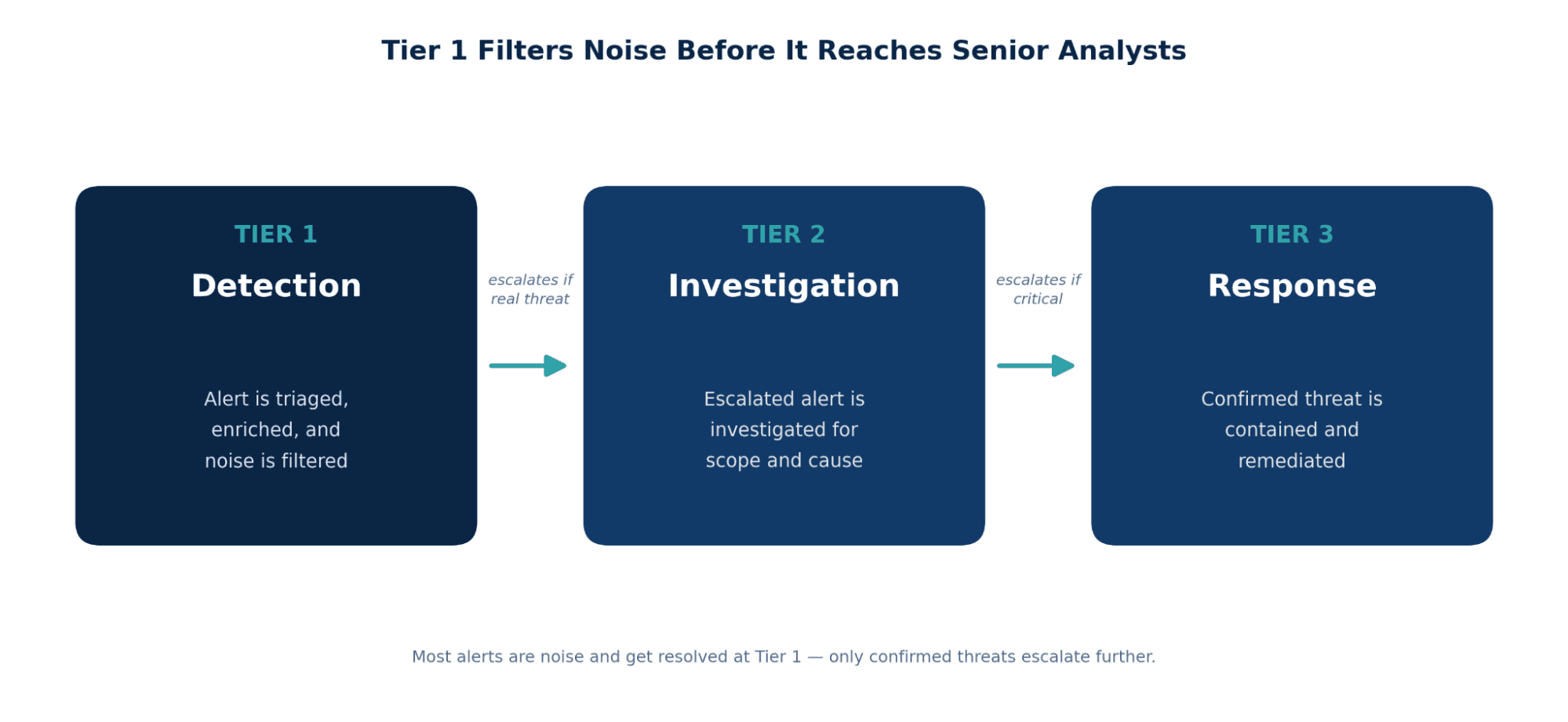
So the real question isn't "how do we fill the seats?" It's this: why is Tier-1 work built in a way that makes good analysts want to leave?
What's Actually Driving Tier-1 Analysts Out
A few patterns keep showing up in Tier-1 exits. None of them are just about pay:
- Alert volume without context. Analysts spend most of a shift jumping between the SIEM, EDR, threat-intel tools, and ticketing systems, just to understand one alert. The alert itself isn't the slow part. Gathering the context around it is.
- Tool sprawl. Juggling five or six separate dashboards for one case is its own fatigue driver, separate from alert count. Industry surveys on SOC stress list "too many tools" as a top complaint, right next to alert volume.
- Bad, quantity-based metrics. Grading Tier-1 only on tickets closed per shift rewards speed over accuracy. It quietly pushes analysts to rubber-stamp alerts instead of checking the ones that deserve a second look.
- Tough shift work and understaffing. Round-the-clock coverage on rotating shifts, plus chronic understaffing, means analysts often do high-stakes work while running on too little sleep. That makes every other problem on this list worse.
- No growth path. Tier-1 should be a stepping stone, not a dead end. When the job is the same 50 alert types for two years, with no path to Tier-2, ambitious analysts leave instead of waiting.
- A recognition gap. This one gets missed a lot. Research on SOC teams shows analysts want stress support and recognition from leaders. But leaders mostly respond by spending more on tools. Better tools help, but if nobody tells analysts the work mattered, tools alone won't stop them from leaving.
None of this gets fixed by hiring more people into the same broken setup. It gets fixed by changing what the workflow asks a human to do. That's the shift we cover in AI SOC Analyst vs. Traditional Tier-1 Analyst. The goal isn't replacing the analyst. It's removing the parts of the job that never needed a trained analyst's attention.
Why MSSPs Struggle More With Tier-1 Burnout
MSSP analyst burnout tends to run ahead of the industry baseline. Here's why: a Tier-1 team at an MSSP handles the alert volume, tools, and SLA pressure of every client at once, not just one environment's noise. Each new client means another dashboard, another set of detection rules to learn, and another SLA clock running at the same time.
This multiplies every driver listed above. Tool sprawl isn't five dashboards; it's five dashboards per client. Alert volume doesn't average out across clients either. It stacks. And because SLA reporting windows are contractual, the pressure to close tickets fast is often higher than in an internal SOC, which pushes straight into the "quantity over accuracy" metrics problem. Turnover also costs an MSSP more than it costs an internal team, since a departing analyst takes client-specific knowledge with them, not just general SOC experience.
How Alert Fatigue Affects MTTD and MTTR
Alert fatigue slows down two key numbers: mean time to detect (MTTD) and mean time to respond (MTTR). Here's why: a worn-down analyst working an unfiltered queue is more likely to skim past the one real alert in a thousand, simply because the last 999 weren't real. Burnout isn't just an HR problem here. It's a detection problem, and both numbers get worse as queues pile up and reviews get rushed.
The failure isn't dramatic. It's quiet. A real warning sign sits unread, buried behind a hundred low-priority duplicates. It might get found days later, during an unrelated case. Or it might not get found at all. This is also where SIEM alert fatigue makes things worse. A SIEM tuned to fire too broadly creates exactly the kind of volume that hurts MTTD and MTTR over time.
How AI and Security Platforms Reduce SOC Analyst Burnout
If you're searching for platforms to reduce burnout among SOC analysts, you're usually facing one of three problems: too many alerts, too many disconnected tools, or too much manual work between an alert and a decision. The platforms that actually help do a few specific things. They don't just slap an "AI" label on the same old workflow:
- Fewer duplicate investigations, through alert correlation and deduplication. Usually handled by a SOAR (Security Orchestration, Automation, and Response) platform, this groups related alerts into one case instead of making an analyst investigate the same incident fifty times.
- Context ready before the analyst arrives, through automated enrichment. This pulls in asset details, identity context, history, and threat-intel matches before a human even opens the alert.
- One workflow instead of five logins, through centralized case management. This replaces five separate tool logins per case with one place that already has the evidence attached.
- Less noise reaching a human, through risk-based alert scoring. This separates alerts that truly need a person from ones that can be closed, logged, or reviewed later.
- A faster first move, through AI-assisted triage suggestions. This recommends a classification and next step, with the reasoning shown, so an analyst can confirm in seconds instead of starting from zero.
Used well, AI doesn't replace an analyst's judgment. It shrinks the gap between an alert coming in and a human being ready to act on it, by removing the manual digging that was never a good use of that judgment in the first place. That's exactly how automated incident response platforms reduce analyst fatigue in practice: not by adding another layer of noise, but by cutting the manual steps between an alert and a decision, the same redesign we walk through in our AI SOC automation guide. That holds whether you're a large MSSP running dozens of client environments or a mid-sized security team without a large Tier-1 bench. A platform that just adds another alert layer on top of existing tools tends to make burnout worse, not better. That's exactly the catch we'll cover next.
Why "Just Add AI" Isn't the Fix Either
Automation sounds like the obvious fix for alert fatigue. Done right, it is. But bolting a generic AI layer onto an already-stressed SOC, without thinking about data handling or where human judgment fits in, creates a new problem. Analysts stop trusting the tool. Or compliance teams lose track of where sensitive data goes.
This matters even more for MSSPs and regulated industries. That's part of why we wrote about on-premise AI SOC automation and why keeping AI in-house beats a cloud security copilot. Some teams simply can't route client security data through a third-party model. The automation has to fit your real constraints, not just cut alert counts on a dashboard.
What Actually Fixes Tier-1 Burnout
Here's the truth: the fixes that work aren't about headcount. They're structural changes to detection rules, alerting, tools, and how the Tier-1 role itself is built.
- Tune detection rules at the source. A lot of alert volume is self-inflicted. Old or badly tuned rules keep firing on known-safe behavior. Retiring noisy rules and adjusting thresholds removes work that never had to exist.
- Use risk-based, tiered alerting. Send high-confidence threats to an active queue analysts actually work. Log low-priority events for later, instead of forcing a full check on every single one.
- Cut down on overlapping tools. Every extra dashboard adds a switching cost. Fewer, connected views cut fatigue no matter how many alerts are firing.
- Automate the enrichment, not the judgment. Let workflows gather context (asset owner, related alerts, past cases, threat-intel matches) before an alert reaches a person, so the human starts at "decide," not "gather."
- Cut real noise, don't just hide it. Group and de-duplicate alerts so one incident shows up once, not fifty times. Analysts get hours back, without missing anything they need to see.
- Build a real ladder inside Tier-1. Rotate analysts into harder queues, threat-hunting work, or automation-building, even before an official Tier-2 promotion. That shows the role is growing with them.
- Close the recognition gap. Show what a shift's work actually caught or prevented, and have leaders acknowledge it out loud. This meets a gap research keeps flagging: analysts want to know the work mattered, not just get more tools.
- Protect focus time and shift-work reality. Constant tool-switching is its own fatigue driver, separate from alert count. So is running a 24/7 rotation without enough people to give analysts real rest between shifts. Protecting sleep schedules and avoiding abrupt, back-to-back rotation changes matters as much as trimming the queue. A well-rested analyst reads the same queue faster and more accurately than an exhausted one.
Cause, Effect, and Fix at a Glance
| Cause | Operational Effect | Best Fix |
|---|---|---|
| Alert volume without context | Analysts spend most of a shift gathering context instead of investigating | Automated enrichment before the alert reaches a human |
| Tool sprawl | Constant context-switching adds its own fatigue, separate from alert count | Consolidate overlapping tools into fewer, integrated views |
| Unrealistic, quantity-based metrics | Rewards speed over accuracy and pressures rubber-stamping | Measure escalation accuracy and time-to-context instead of tickets closed |
| Disruptive shift rotations and understaffing | Compounds every other fatigue driver through a chronic sleep deficit | Staff to actual volume and protect real recovery time between shifts |
| No path beyond Tier 1 | Ambitious analysts leave rather than wait for a ceiling that never lifts | Build a visible ladder inside Tier-1 itself |
| Recognition gap | Analysts feel unseen despite investment in tooling | Pair visible reporting with genuine leadership acknowledgment |
What Managers Should Measure Instead of Tickets Closed
Tickets closed per shift is easy to track. It's also actively harmful. It's the metric most responsible for the "quantity over accuracy" pressure described earlier. A better scorecard looks at what actually shows whether Tier-1 work is done well, not just done fast:
- Escalation accuracy. How often does a Tier-1 escalation to Tier-2 turn out to be a real issue? Not just how many escalations happen.
- Time-to-context, not time-to-close. How long does it take an analyst to get what they need to make a confident call? This is where most manual time actually goes.
- False positive and dismissal rates. How much of what's flagged actually needs action, and how much gets closed without one? A high dismissal rate isn't just a rules problem. It's a direct measure of how much noise analysts are wading through.
- Re-opened or missed cases (a true miss rate). Alerts closed as "nothing" that later turned out to matter. Ticket-closed counts hide this completely, and it's a better read on real risk than raw alert volume ever is.
- Analyst-reported confidence, tracked over time. A simple, regular check-in: do analysts feel they have enough context and time to do the job right?
None of these are harder to track than tickets closed. They're just less commonly asked for, which is part of why the wrong metric sticks around.
The SOCs that keep their Tier-1 talent aren't the ones with the fewest alerts. They're the ones where an analyst's time goes toward decisions, not data collection, and where people know their work is seen.
Where This Fits Into a Bigger SOC Strategy
Fixing Tier-1 burnout is one part of a bigger question: how much of the SOC's triage and response should be automated, and where should a human stay fully in control? That's the design problem behind AI-powered SOC automation done right. The goal isn't removing analysts from the loop. It's giving them a role worth staying in.
Frequently Asked Questions
The main drivers are high alert volume with little context, tool sprawl, quantity-based metrics, tough shift rotations combined with understaffing, no growth path inside Tier-1, and a recognition gap between analysts and leadership.
It's the desensitization that builds up when analysts see too many low-value or false alerts. Over time, it gets harder and slower to spot a real threat in the noise.
Physical exhaustion (fatigue, headaches, sleep trouble), rising missed or misclassified alerts, rubber-stamped escalations, skipped context-gathering steps, more sick days or late arrivals, visible cynicism about the work, and slower response times or a creeping rise in MTTR on cases that used to move quickly.
Not on its own. Adding people to the same manual, under-tooled workflow just produces the same burnout timeline for the new hires. The workflow itself needs to change: alert volume, tool count, enrichment, and career path all have to be addressed.
A worn-down analyst working an unfiltered queue is more likely to miss the rare real alert sitting among hundreds of duplicates. That shows up as slower mean time to detect and mean time to respond.
MSSP analysts absorb the combined alert volume, tooling, and SLA pressure of every client at once, instead of just one environment's noise. That compounds tool sprawl and bad metrics faster than in an internal SOC.
Escalation accuracy, time-to-context, false positive and dismissal rates, the rate of re-opened or missed cases (a true miss rate), and analyst-reported confidence give a truer picture of Tier-1 health than raw ticket counts.
Platforms that combine alert correlation, automated enrichment, centralized case management, and risk-based scoring in one workflow are the ones that actually cut Tier-1 workload and burnout. Adding another disconnected dashboard on top of existing tools won't get you there.
AI mainly handles alert enrichment, deduplication, and triage suggestions, so analysts spend their time on decisions instead of manually gathering context for every single alert.
AI helps by correlating and deduplicating related alerts into one case, automatically enriching alerts with asset and threat-intel context, scoring alerts by risk so low-priority ones don't need manual review, and suggesting a triage classification an analyst can confirm in seconds.
They cut the manual steps between an alert firing and a human making a decision: pulling in context automatically, grouping related alerts, and routing only the alerts that need a person's judgment to an active queue.